To keep beauty clients coming back, deliver a result they value, agree on the next step, offer the next appointment before they leave, make rebooking easy, follow up usefully, and remember the details that matter when they return.
Glamorph supports that routine with online booking, email, SMS and WhatsApp appointment reminders and a connected history of each client’s services, preferences, photos, documents and payments. It helps you prepare for a return visit. It does not guarantee rebookings or replace your own follow-up.
Retention is not one reminder or loyalty discount. It is the full experience from consultation to the next booking. A multi-country Phorest survey of salon clients found that the relationship with the service provider was a recurring reason people stayed loyal, alongside factors such as quality, availability, price, convenience, atmosphere, and hygiene.
What does beauty client retention mean?
Beauty client retention means clients return for another appropriate service instead of every appointment being a one-off. Rebooking, retention, and win-back are related, but they are not the same measure.
| Measure | A practical definition | What it tells you |
|---|---|---|
| Prebooking rate | Eligible completed appointments that leave with a future appointment already booked | Whether you make the next step easy before checkout |
| Return rate | Eligible clients who come back within a time window you define | Whether the overall client experience creates a return |
| Win-back rate | Inactive clients who return after a relevant personal message or campaign | Whether lapsed-client outreach is useful |
There is no honest universal retention target for every beauty business. A weekly blow-dry, a three-week lash fill, a six-week color appointment, and occasional bridal makeup have different return patterns. Choose the services that are expected to repeat, define the window, and compare the same measure over time.
1. Give every client a clear next-service plan
Before checkout, explain what should happen next and why. The recommendation should follow the service and the client’s goal, not a script designed only to fill the calendar.
Examples:
- “Let’s review the fade in six weeks and decide whether you need a gloss or a full color.”
- “Your next lash fill will depend on wear, but three weeks is a sensible point to check.”
- “For the wedding day, I will keep the skin finish from today’s trial and soften the liner.”
- “Let’s compare today’s progress photos before choosing the next treatment.”
Record that next step while it is fresh. A recurring-client workflow is most useful when it carries the plan from one appointment into the next instead of storing disconnected notes.
2. Ask to rebook before the client leaves
Do not make a good client remember to contact you later. Once you have agreed on the likely timing, offer a real next appointment.
Try:
Based on today’s service, I would check this again in about [time]. Would you like to reserve your next appointment now, while we can still choose a time that works for you?
This should feel helpful, not compulsory. If the client is unsure, tell them how far ahead your popular times usually fill and give them the easiest way to book later. Do not invent urgency or pressure someone into a service they may not need.
3. Make rebooking easy
A client can intend to return and still disappear if booking means several messages about services, dates, and available times.
Keep the path simple:
- Use service names a client understands.
- Show accurate availability.
- Explain whether a request is confirmed immediately or needs approval.
- Make rescheduling and cancellation rules easy to find.
- Keep the booking connected to the same client history.
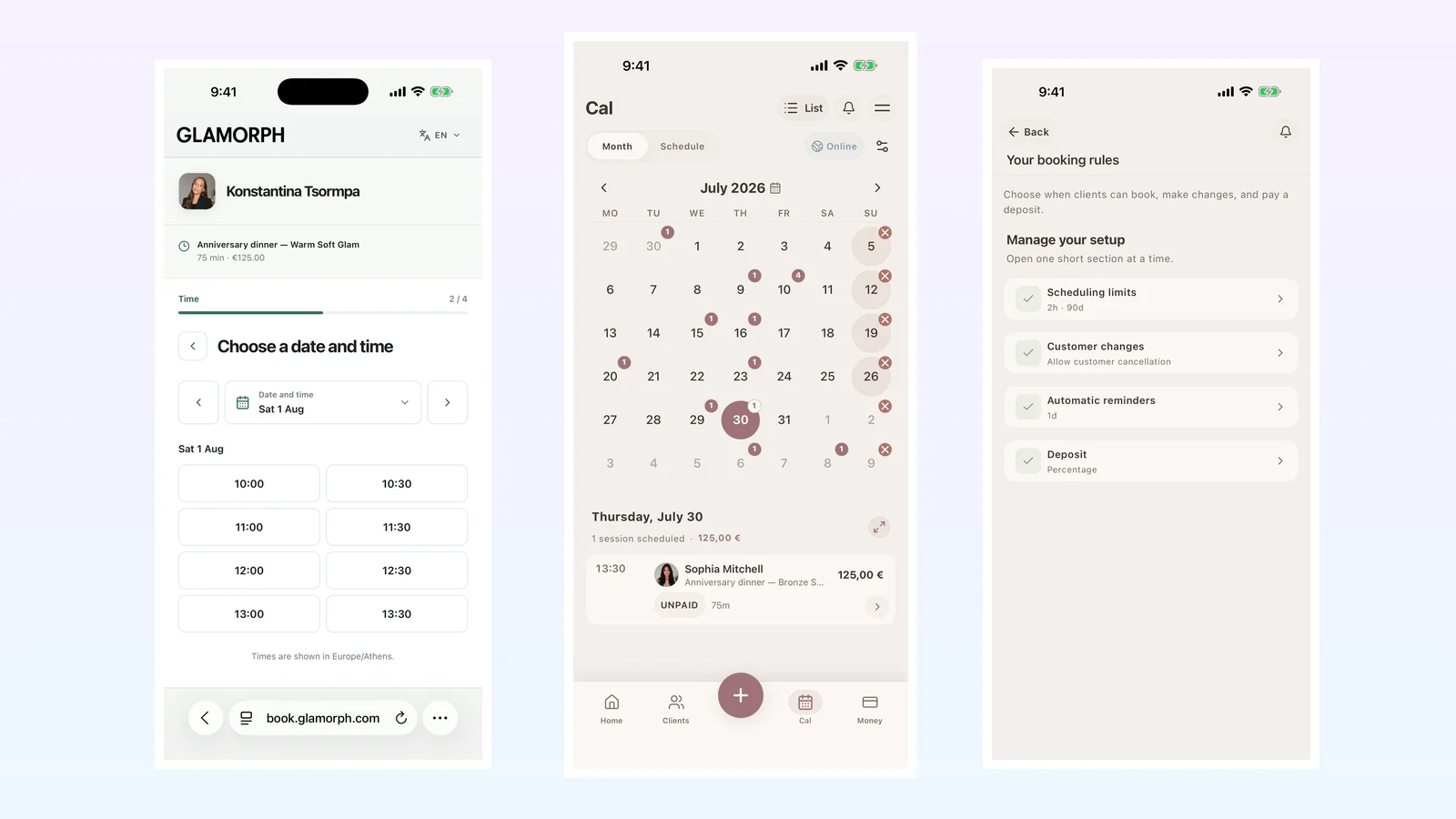
A public online booking page for beauty professionals can remove the message back-and-forth while still respecting your availability and approval rules. If you are choosing a tool, the beauty booking software comparison explains which products fit solo providers, small teams, marketplaces, and broader salon operations.
Once the appointment exists, an appointment reminder helps the client act on that booking. It is different from a later message asking the client to rebook. Glamorph can send automatic appointment reminders by email, SMS or WhatsApp for confirmed online bookings and appointments you enter yourself. WhatsApp requires a connected business number, an approved message and client permission. SMS availability and costs vary.
4. Follow up with useful aftercare
A short follow-up can continue the service after the client leaves. Send the information at a time when it is useful, not as a generic “book again” blast.
A good follow-up may:
- Restate the relevant aftercare discussed at the appointment
- Ask how the result is wearing or whether the client has a question
- Remind the client what change you agreed to review next time
- Include the booking link when the likely return window is approaching
Keep service instructions separate from marketing permission, and follow the communication-consent rules that apply where you work. The guide to beauty consent forms and aftercare records explains why consultation, service consent, photo permission, and aftercare should remain distinguishable even when they use one digital workflow.
5. Remember the details that matter
Personalization is not using a first name in an automated message. It is remembering what happened and using that context appropriately at the next visit.
Write a two-minute note after every appointment. It should answer:
- What service did I provide?
- Which products, shades, formulas, or settings did I use?
- What did the client ask for?
- What did she like or want changed?
- Was there a reported sensitivity, reaction, or comfort issue?
- What should I check or prepare next time?
A useful note is specific enough to act on. “Soft glam” is vague. “Dewy finish, matte through T-zone, shade mix noted, individual lashes on outer corner, use less powder under eyes next time” is reusable.
Keep stable details in the client profile and appointment-specific details in the session. A client-management system makes that distinction easier to maintain as the client list grows.
Record client-reported allergies and sensitivities clearly
If a client mentions a product reaction, eye sensitivity, adhesive issue, fragrance sensitivity, or another relevant concern, record what she actually said before the detail disappears into an old message.
Avoid turning the note into a diagnosis.
| Too vague | More useful record |
|---|---|
| “Allergic” | “Client reports a previous reaction to [product or ingredient, if known]. Review before next service.” |
| “Sensitive eyes” | “Eyes watered with previous strip-lash application. Discuss adhesive and placement before starting.” |
| “Product issue” | “Client reported itching the evening after last service. Product unknown. Follow applicable protocol.” |
The record helps you review known information. It does not guarantee that a reaction cannot happen, and it does not replace your training, product instructions, insurer requirements, or local rules.
Keep before-and-after photos with the session
Photos help with repeat work only when you can connect them to the correct client, date, service, products, and permission status.
Instead of relying on the camera-roll date:
- Attach the photo to the appointment it came from.
- Label it Before, Progress, or After.
- Add only a few tags you will genuinely search.
- Keep private-record permission separate from public marketing permission.
- Write product and result details in the session note.
The guide to organizing before-and-after client photos includes a simple tagging and permission workflow.
For a repeat client, the combination of photo and note is more useful than either one alone. You can see the result and understand how it was created.
Check the history before the client arrives
Set aside 30 to 60 seconds before a repeat appointment to review:
- The last service and date
- Products, shades, formulas, or settings
- Client feedback and reported sensitivities
- Photos and result notes
- Deposit or balance status
- The planned next step
This small review reduces repeated questions and gives you a better starting point for today’s consultation. The current appointment may still need a different plan. History is context, not an instruction to repeat everything unchanged.
A session-history view is useful because it keeps changes chronological instead of overwriting the previous record.
6. Ask for feedback and handle small misses well
Do not wait for a public review to learn that a client was uncomfortable, confused, or disappointed. Ask a specific question while the service is still fresh:
How did the result feel after you left, and is there anything you would want me to adjust next time?
Record useful feedback without becoming defensive. If something needs attention, respond promptly, explain the options you can genuinely offer, and keep the conversation with the correct client and appointment. A reliable recovery from a small issue can protect trust. Silence cannot.
Not every client is the right long-term fit. Retention does not mean ignoring boundaries, unsafe requests, repeated no-shows, abusive behavior, or a service you are not qualified to provide.
7. Win back quiet clients without discounting everything
Start with clients whose normal return window has passed, not the entire database. Check their last service, usual interval, result, feedback, and next-step note before writing.
A simple message:
Hi [name], I was reviewing your last [service] and the note we made about [specific next step]. How has it been wearing? If you are ready to revisit it, here is my booking link: [link].
The 2026 Zenoti win-back guide uses visit intervals and service history to time rebooking and lapsed-client messages. Its benchmark data comes from larger North American salon datasets, so use it as an industry example—not as a universal schedule for your own clients.
Do not lead every message with a discount. A relevant check-in, a useful next-service recommendation, or an easier booking path may be enough. If you do use an offer, measure whether those clients return again without another discount.
A simple repeat-client workflow
Use this after every service:
| When | Action |
|---|---|
| Before the appointment | Review the last session, photos, sensitivities, payment status, and next-time note |
| During the consultation | Confirm what has changed and agree on today’s plan |
| After the service | Save products, result, photos, payment, client feedback, and next step |
| Before publishing media | Check the specific photo-permission status |
If you are a makeup artist, the freelance makeup artist client-management guide shows this with products, shades, trials, and deposits. For nail services, the nail tech client app guide includes products, wear, repairs, and design history.
How to measure beauty client retention
Choose a fixed period and keep the denominator consistent.
Prebooking rate = eligible completed appointments with a future booking / eligible completed appointments

Return rate = eligible clients who returned within the chosen window / eligible clients due to return
Then segment the result by new versus returning clients, service, and—if you have a team—professional. A combined number can hide that one service naturally repeats every three weeks while another is occasional.
Track at least:
- The last completed appointment
- Whether a future appointment was booked before checkout
- The expected return window for that service and client
- Whether the client returned inside that window
- Cancellation or no-show context
- The last relevant follow-up
Avoid publishing an arbitrary “good salon retention rate” as your target. Improve your own like-for-like baseline first, then compare external benchmarks only when their definition, market, business type, and measurement window are clear.
Where Glamorph helps
Glamorph keeps online booking, client profiles, preferences, reported allergies and sensitivities, sessions, formulas, photos, documents, payments, expenses, and appointment history together across mobile and web, including offline client-record workflows. A confirmed self-booking joins the same calendar and client history you review before the next visit.
For a small team, separate logins and roles let the professional seeing the client review the permitted history without sharing the owner’s account. Appointment reminders by email, SMS and WhatsApp can be automated once the relevant channel is ready and client permission is recorded where required. The personal check-ins, win-back messages and retention calculations described in this guide are work for your business to carry out, not a claim that Glamorph runs those campaigns or reports automatically.
It is built for booking and record continuity: making the next appointment easier, remembering what happened, and finding the relevant history before the next service. It does not replace the quality of the service, your follow-up, or the relationship you build.
Beauty client retention checklist
For each repeatable service, check whether you can answer:
- What result and client experience am I promising consistently?
- What is the normal next step, and did I explain it?
- Did I offer a real next appointment without pressure?
- Can the client rebook without unnecessary messages?
- Is the aftercare or follow-up useful and properly permitted?
- Can I find the client’s products, preferences, sensitivities, feedback, photos, and next-step note?
- Do I know which clients are due to return and which have gone quiet?
- Am I measuring prebooking and return with a consistent definition?
If those answers are scattered across DMs, a camera roll, Notes, and payment screenshots, the retention problem may partly be a retrieval problem. Put the client history in one place and build the habit one appointment at a time.
FAQ
What is the best way to get beauty clients to rebook?
Agree on a useful next-service plan, explain the timing, and offer a real appointment before the client leaves. If they are not ready, give them a simple booking link and follow up near the relevant return window.
Should I offer discounts to keep beauty clients?
Not by default. First improve the result, experience, availability, rebooking path, follow-up, and personalization. Use an offer deliberately for a specific group, then measure whether those clients return again without another discount.
When should I follow up after a beauty appointment?
It depends on the service and why you are contacting the client. Send aftercare when it is useful, check the result at an appropriate point, and send a rebooking reminder near the client’s expected return window. Follow the communication and consent rules that apply to your business.
Can I automate a reminder for a beauty appointment I added manually?
Yes. Choose email, SMS or WhatsApp on a manually entered appointment. Confirmed online bookings have separate settings, with multiple email times and one timing each for SMS and WhatsApp. Sending depends on channel readiness, contact details and client permission. Rescheduling or cancelling updates pending reminders.
What details help personalize a repeat beauty appointment?
Save the previous service, products, shades, formulas or settings, client feedback, reported sensitivities, photos and permission, result, payment status, and the agreed next step. Review the history before the client arrives.
Written by
Professional makeup artist and founder of Glamorph
Makeup artist and Glamorph founder with 5+ years of experience. Working closely with professionals across the beauty industry, she writes about client management, booking and everyday salon workflows.
You might also like
Best Beauty Salon Booking Software in 2026: 6 Systems Compared
Compare six beauty salon booking systems for solo professionals and small teams: online booking, deposits, reminders, client records and everyday use.
Read more
Freelance Makeup Artist Client Management
See how Glamorph connects makeup bookings, trial notes, product shades, photos, signed forms and payments in one client-management workflow.
Read more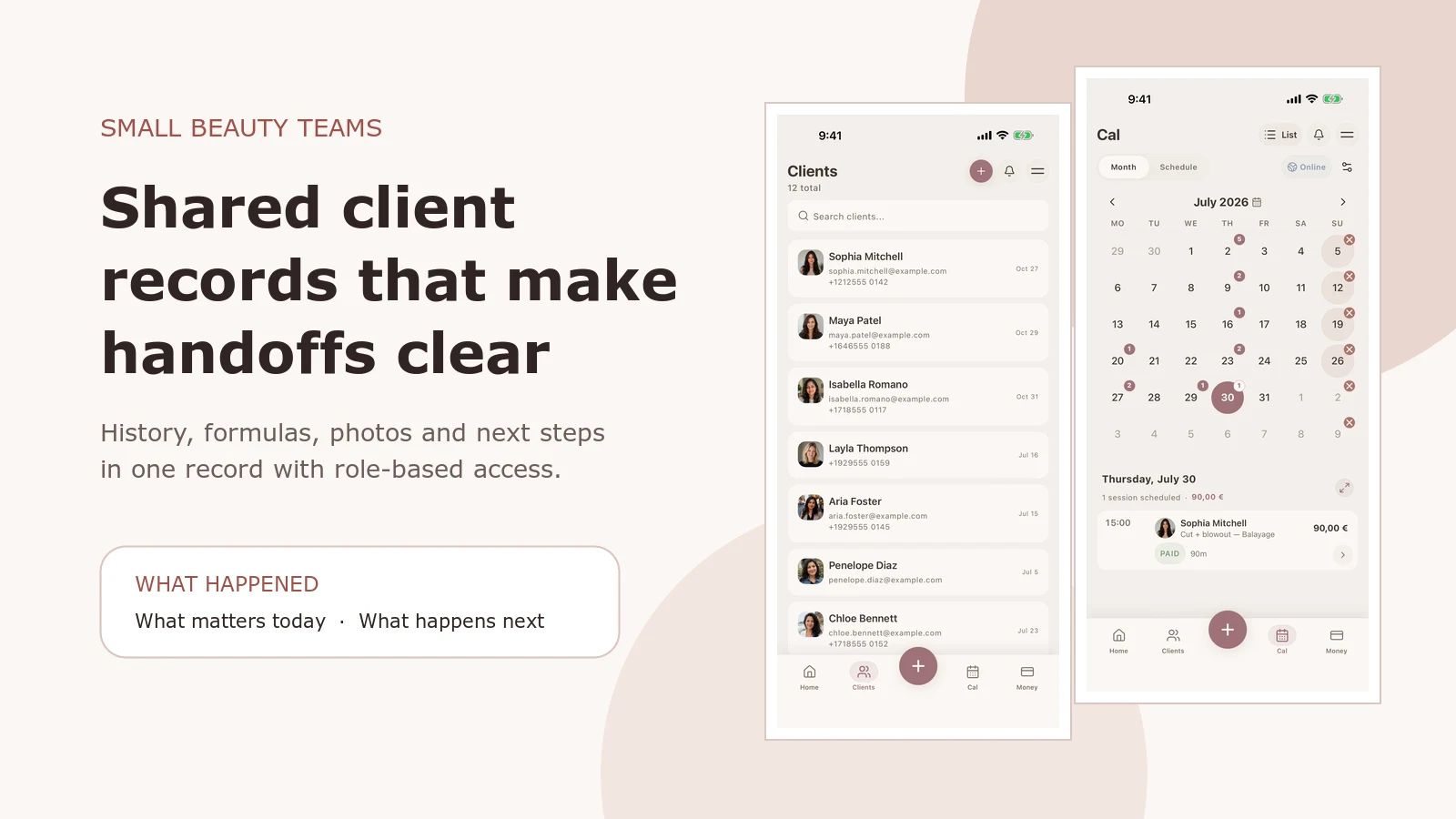
Salon Client Management Software: A Small-Team Workflow
See how Glamorph connects salon client records, booking, photos, signed forms, payments and team access. A practical workflow for small beauty teams.
Read more