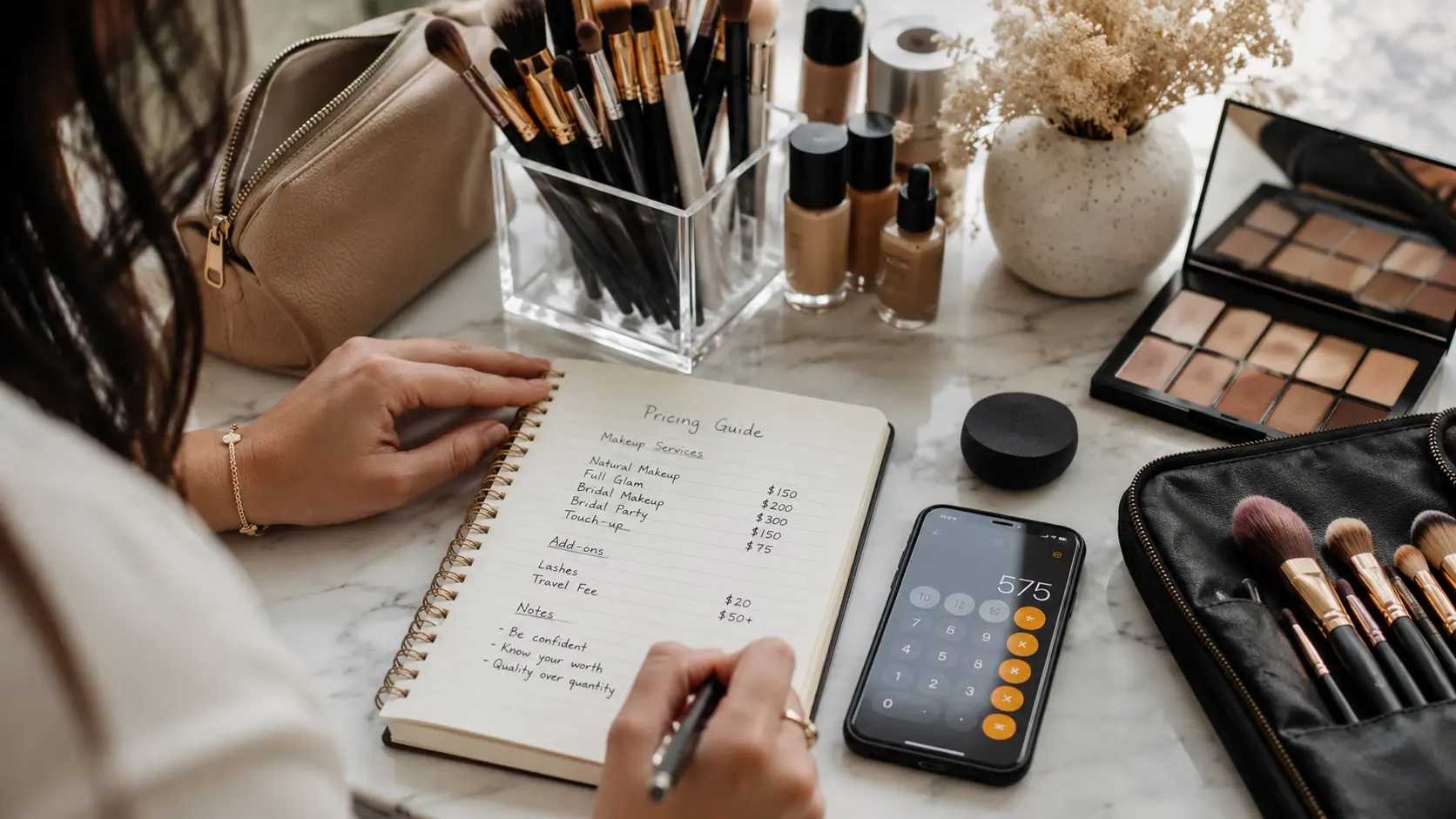
If you are setting your own freelance prices, a beginner makeup artist often starts around $60 to $100 for simple event makeup, $90 to $150 for trials, and $120 to $250+ for bridal makeup.
But those numbers are only starting examples. Your real price should depend on your location, skill level, kit cost, travel time, demand, and how much work happens before and after the appointment.
There is no perfect official price list for beginner freelance makeup artists. So instead of copying random prices online, use a simple rule:
Your price should make the booking worth your time after products, travel, prep, cleanup, client communication, and payment tracking.
A Quick Wage Sanity Check
Before choosing your prices, it helps to look at beauty-industry wage data.
Official wage data is not a freelance rate card. It will not tell you what to charge for a prom client, bridal party, or mobile soft glam appointment. But it can keep you from pricing so low that your real hourly rate makes no sense.
The BLS May 2025 national occupational wage table lists a median wage of about $46.71 per hour for theatrical and performance makeup artists, $17.21 per hour for hairdressers, hairstylists, and cosmetologists, and $21.79 per hour for skincare specialists. The O*NET profile for theatrical and performance makeup artists is also useful context because that occupation is different from freelance event and bridal work.
So do not copy those wages directly. Use them as a sanity check.
If a mobile makeup booking takes three hours from messages to cleanup, and your real take-home ends up around $12 per hour before tax, your price may be too low.
Quick Beginner Makeup Artist Pricing Examples
Use this table as a starting point, not a rule.
| Service | Beginner price example | Notes |
|---|---|---|
| Simple event makeup | $60-$100 | Good for birthdays, parties, graduations, and soft glam |
| Full glam | $80-$130 | Charge more if the look takes longer or includes lashes |
| Photoshoot makeup | $90-$150 | Depends on time on set, touch-ups, and usage |
| Bridal trial | $90-$150 | A trial is still a paid service |
| Bridal makeup | $120-$250+ | Bridal work usually includes consultation, timing, and long-wear expectations |
| Bridesmaid or guest makeup | $80-$150 | Often priced lower than bridal makeup |
| Travel fee | $15-$60+ | Depends on distance, parking, tolls, and time |
| Deposit | 20%-50% | Helps protect your calendar from cancellations |
If you are outside the US, use your local currency and your local market. The logic is the same.
Before publishing your prices, check a few artists in your area. Look at beginner artists, mid-level artists, and established bridal artists. Do not copy them exactly. Use them to understand what clients near you are already used to paying.
Why Copying Another Artist’s Prices Does Not Work
Two makeup artists can both charge $90 and have completely different profits.
One artist might work from home, have no travel, use a simple kit, and finish quickly.
Another artist might drive 40 minutes, include lashes, pay for parking, clean a full brush set, answer client questions, and spend extra time taking photos.
Same price. Different reality.
That is why the better question is not:
What does everyone else charge?
The better question is:
What do I actually keep after costs and time?
The Real Booking Math Method
Before choosing a price, calculate this:
Then calculate:
Example:
| Item | Amount |
|---|---|
| Client pays | $90 |
| Product usage | -$8 |
| Travel cost | -$12 |
| Other booking costs | -$3 |
| Real income before tax | $67 |
Now count the time.
| Task | Time |
|---|---|
| Messages and booking | 20 min |
| Kit prep | 15 min |
| Travel | 40 min |
| Makeup service | 90 min |
| Cleaning and notes | 15 min |
| Total time | 3 hours |
So this was not really $90 for 90 minutes.
It was about $67 for 3 hours before tax. That is around $22 per hour before tax.
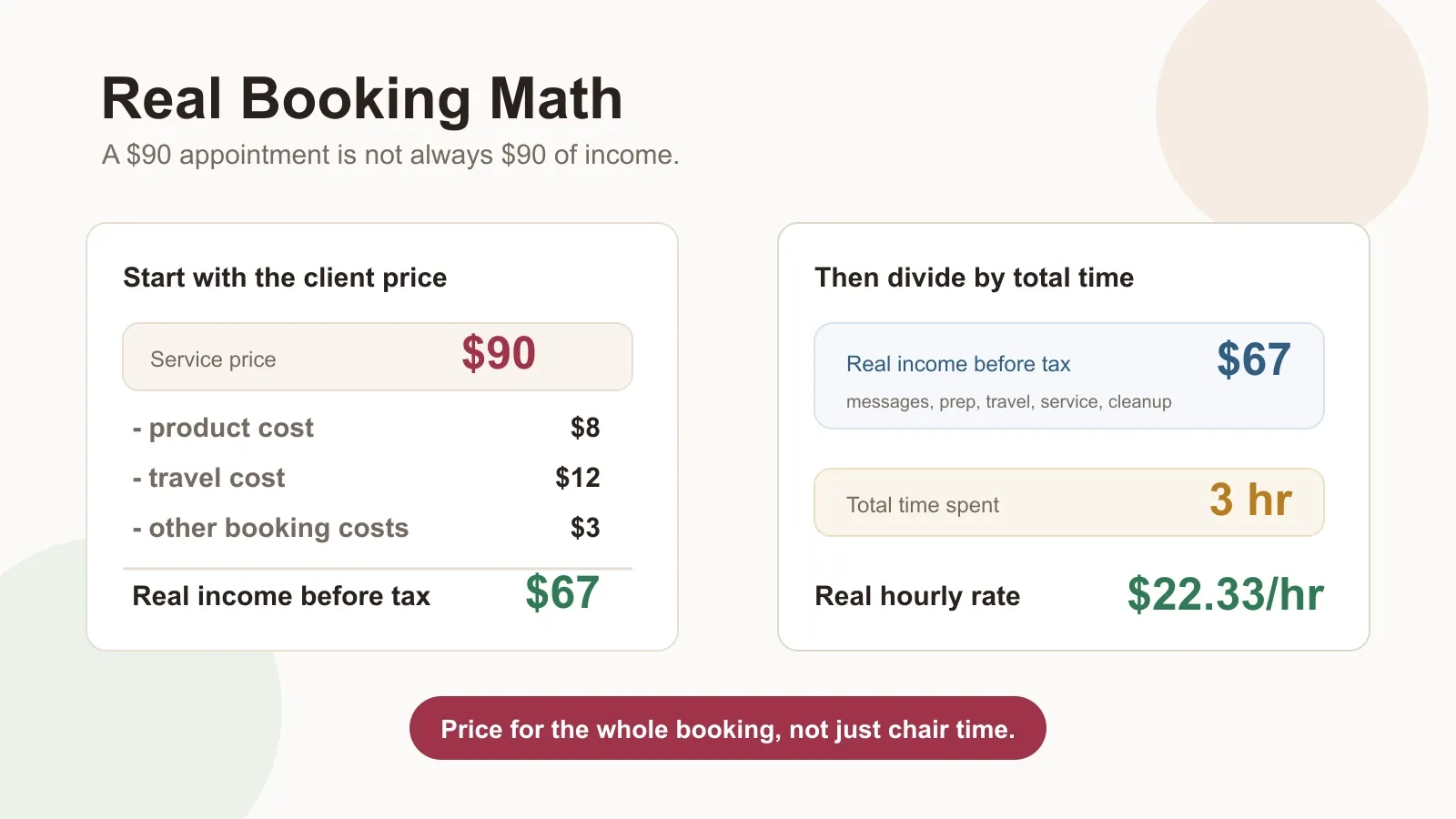
The price on your menu matters less than what you keep after time and costs.
Try the Beginner Makeup Artist Pricing Calculator
Use this simple calculator before posting a new service price. It is not tax advice and it is not a perfect business plan. It is a quick way to stop guessing.
Pricing calculator
Estimate your real hourly rate
Enter one booking and see what you keep before tax after products, travel, parking, and other booking costs.
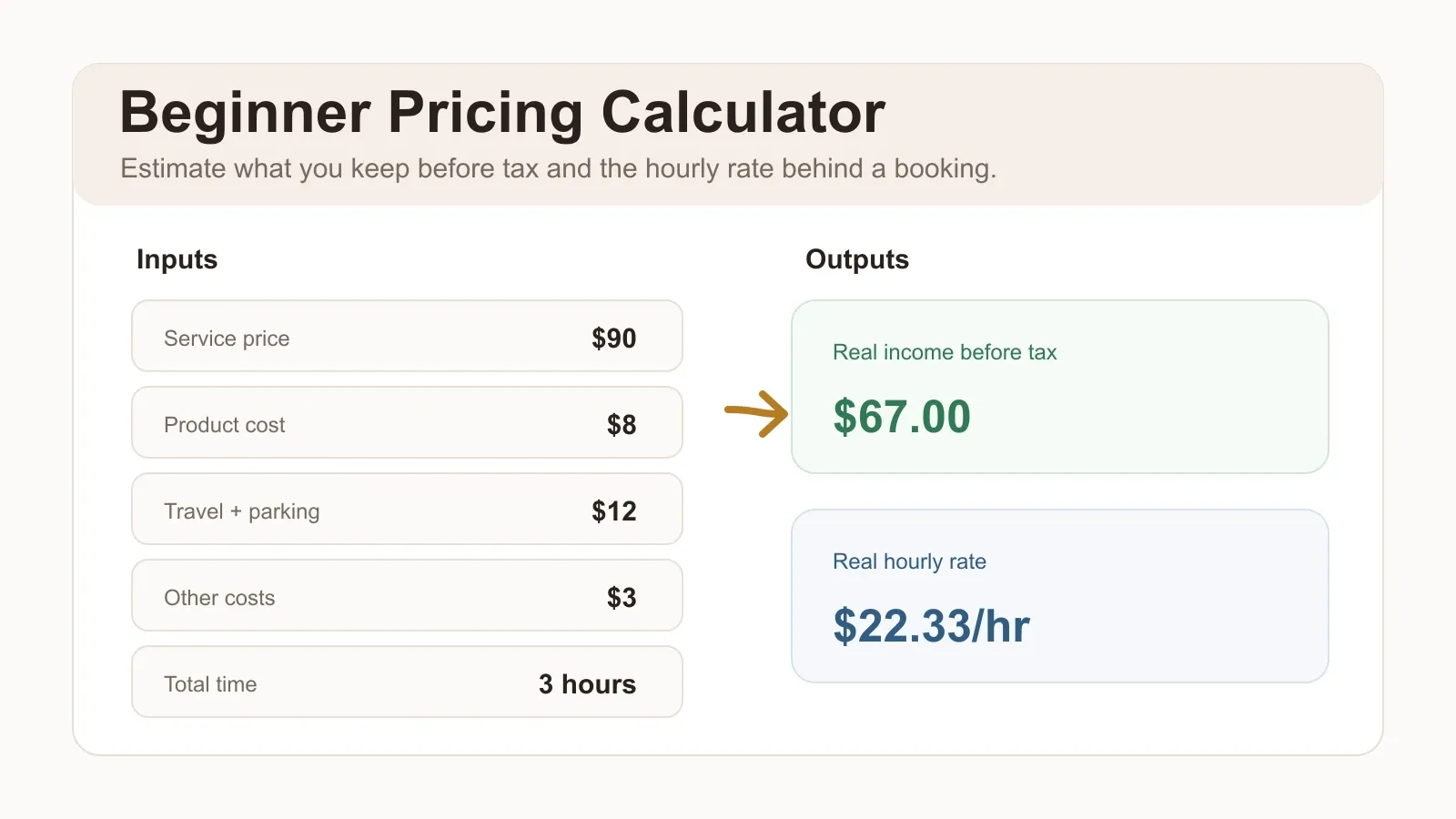
Use the same math for event makeup, bridal trials, bridal makeup, bridesmaids, photoshoots, and mobile bookings.
Do the same calculation again after a month of real appointments. Record actual product and travel costs with expense tracking, then compare them with the service price and time you expected. Your own bookings are more useful than a copied price list because they show which services are actually sustainable for you.
Cheap Booking vs Better-Priced Booking
This is where pricing becomes obvious.
| Input | Cheap booking | Better-priced booking |
|---|---|---|
| Client pays | $60 | $100 |
| Product cost | -$8 | -$8 |
| Travel cost | -$12 | -$12 |
| Other booking costs | -$2 | -$3 |
| Real income before tax | $38 | $77 |
| Total time spent | 3 hours | 3 hours |
| Real hourly rate | $12.67/hour | $25.67/hour |
The difference is not just $40.
The better-priced booking almost doubles your real hourly rate. That is why small price increases matter.
How Much Should Beginner Bridal Makeup Artists Charge?
Bridal makeup should not be priced as event makeup plus a random wedding fee.
Price it by what the booking actually includes.
Wedding-cost guides show why bridal quotes vary so much. WeddingWire’s cost guide says wedding hair and makeup in the U.S. is often around $300 and can range much higher or lower depending on location and complexity. The Knot’s current cost guide gives similar average context for bridal hair and makeup, while Zola’s guide points out that trials, travel, upgrades, and tips can change the final total.
Those sources are not a beginner makeup-only rate card. They are market context. For a beginner makeup artist, a bridal makeup application might start around $120 to $250+, depending on your city, portfolio, speed, kit, travel, and the kind of wedding market you serve.
If your next question is specifically about your first wedding booking, read the full guide on how much to charge for your first bridal makeup job.
What matters is the scope.
Bridal pricing may include:
- A consultation or inspiration review
- Skin prep notes or product recommendations
- A paid trial or preview, if booked
- Face chart, product notes, and look adjustments after the trial
- A longer appointment buffer on the wedding day
- Long-wear, waterproof, and photo-friendly product choices
- Lashes, only if you include them
- Travel to a venue, hotel, or home
- Parking, tolls, or public transport
- Early morning call times
- Timeline coordination for the bride and bridal party
- A touch-up kit, if you include one
- Standby touch-ups, only if the client pays for extra time on site
Here is a more professional way to build the quote.
| Pricing part | What it covers | Beginner example |
|---|---|---|
| Wedding-day bridal makeup | Bride’s makeup application, skin prep, long-wear product choices, buffer time | $120-$250+ |
| Bridal trial / preview | Separate appointment, testing the look, notes, small revisions | $90-$150+ |
| Travel and parking | Real travel time plus direct costs | $15-$70+ |
| Early start | Very early call time that blocks the morning | Optional flat fee |
| Bridal party or guest makeup | Clear per-person service with a wedding-morning schedule | $80-$150 |
| Standby touch-ups | Staying after the application for touch-ups or look changes | Hourly add-on |
A simple beginner bridal quote could look like this:
| Line item | Example |
|---|---|
| Bridal makeup application | $160 |
| Bridal trial / preview | $120 |
| Travel and parking | $35 |
| Total before deposit | $315 |
If the bride does not want a trial, do not hide the trial price inside the wedding-day service. Quote the wedding-day makeup, travel, and any add-ons clearly.
Your bridal trial should still be paid.
A trial uses your time, kit, products, sanitation, notes, and expertise. Even if the bride does not book the wedding day, you still provided a real service.
Should You Take a Deposit?
Yes. For serious bookings, deposits are normal.
A deposit protects your calendar. If someone books your Saturday morning and cancels the night before, you may not be able to replace that appointment.
Simple beginner deposit examples:
| Booking type | Deposit example |
|---|---|
| Event makeup | $20-$40 |
| Bridal trial | $30-$60 |
| Bridal makeup | 25%-50% |
| Bridal party booking | 25%-40% of the total |
Example deposit message:
Perfect, I would love to save [date/time] for you. I usually take a [amount] deposit to confirm the booking, and the rest can be paid on the day. Once that is sent, I will add you to my calendar.
Example cancellation wording:
Just so everything is clear before we confirm: because I am saving that appointment time for you, deposits are not usually refundable for cancellations within [X hours/days]. If something changes and I have another time available, I will do my best to move it once.
Use your own voice when you write this. The point is not to sound strict. The point is to make the booking clear before anyone is confused.
Also check what is allowed in your country, state, or local area before using any deposit or cancellation wording.
How to Charge for Travel
Travel is not just fuel.
Travel can include:
- Driving time
- Parking
- Tolls
- Public transport
- Carrying your kit
- Time you cannot book another client
You can keep travel pricing simple at the beginning.
| Distance or time | Travel fee example |
|---|---|
| Very local | Free or $10-$15 |
| 15-30 minutes away | $20-$35 |
| 30-60 minutes away | $40-$70 |
| Over 1 hour | Custom quote |
If parking costs money, add it.
If the client is far away, charge for the time.
If the booking requires an early morning start at a hotel, venue, or home, price that into the booking.
Travel pricing is easiest when it sounds simple and normal.
Example travel message:
I can come to [location]. Because it is outside my usual area, travel would be [amount], so the total would be [total].
Charging for travel is not being difficult. It helps make sure the booking still makes sense for your time, and it helps the client understand the full price before the day of the appointment.
Common Pricing Mistakes Beginner Makeup Artists Make
| Mistake | Why it hurts |
|---|---|
| Charging only for makeup time | Ignores messages, prep, cleanup, and travel |
| Not taking deposits | Makes cancellations more painful |
| Not charging travel | Turns mobile bookings into low-profit bookings |
| Not charging for trials | Bridal trials still use time and products |
| Including too much for free | Makes your price look cheaper than it really is |
| Never raising prices | Keeps you stuck at beginner rates |
| Not tracking payments | Makes it easy to forget balances |
| Copying another artist exactly | Their costs, market, and demand may be different |
If you fix only one thing, start by tracking your real hourly rate.
That one number will show you very quickly if your prices make sense.
When Should You Raise Your Prices?
Raise your prices when:
- You are getting steady bookings
- Clients are happy with your work
- You have strong before-and-after photos
- You have reviews
- People are referring you
- Your weekends are filling up
- Your kit costs have gone up
- Your current price no longer feels worth it
You do not need a huge price jump.
Raise slowly.
| Old price | New price |
|---|---|
| $70 | $80 |
| $80 | $90 |
| $90 | $100 |
You do not need to message every old client with a dramatic price announcement.
Update your menu, your booking page, and your saved replies. Then, when someone asks to book again, say it naturally.
Example price update message:
I would love to see you again. Just a heads-up, my current price for [service] is [price]. If that works for you, I can save [date/time].
If a client already has a confirmed appointment, keep the price you agreed on unless you clearly discussed something different before they booked.
You do not need to apologize for raising your prices.
If your work, experience, kit, and demand have improved, your prices should improve too.
Beginner Makeup Artist Pricing Checklist
Before you post your prices, check this:
- Did I look at local prices?
- Did I include product cost?
- Did I include travel?
- Did I include parking or tolls?
- Did I charge for bridal trials?
- Did I create a deposit policy?
- Did I calculate my real hourly rate?
- Did I leave room to raise prices later?
You do not need perfect prices on day one.
You need prices that protect your time, make sense for your market, and help you grow without burning out.
Track Every Payment, Deposit, and Client Note
Pricing gets easier when you track what actually happens with each booking.
You should know:
- Who paid a deposit
- Who still owes a balance
- How much each client paid
- What products you used
- Which looks took longer than expected
- Which clients came back
- Which services made the most money
- Which bookings were not worth the time
You can track this in a notebook, spreadsheet, or client management app.
Glamorph’s client management workflow for makeup artists connects online booking, appointments, product notes, photos, signed documents and payments. Save the service price and actual work with the session so you can review what the booking earned and what it involved.
You can also collect deposits and balances, rather than only note that they were paid. Connect Stripe, SumUp or Square, then use a payment link or a supported phone or terminal method. Confirmed payments stay with the client and appointment. Availability and fees depend on your business country, provider, account and device. Cash and external payments can still be entered manually.
If you are choosing a tool to manage those bookings, compare makeup artist software for booking, client history and payments. The guide explains how the options fit different working styles and what to check before choosing a plan.
Written by
Professional makeup artist and founder of Glamorph
Makeup artist and Glamorph founder with 5+ years of experience. Working closely with professionals across the beauty industry, she writes about client management, booking and everyday salon workflows.
You might also like
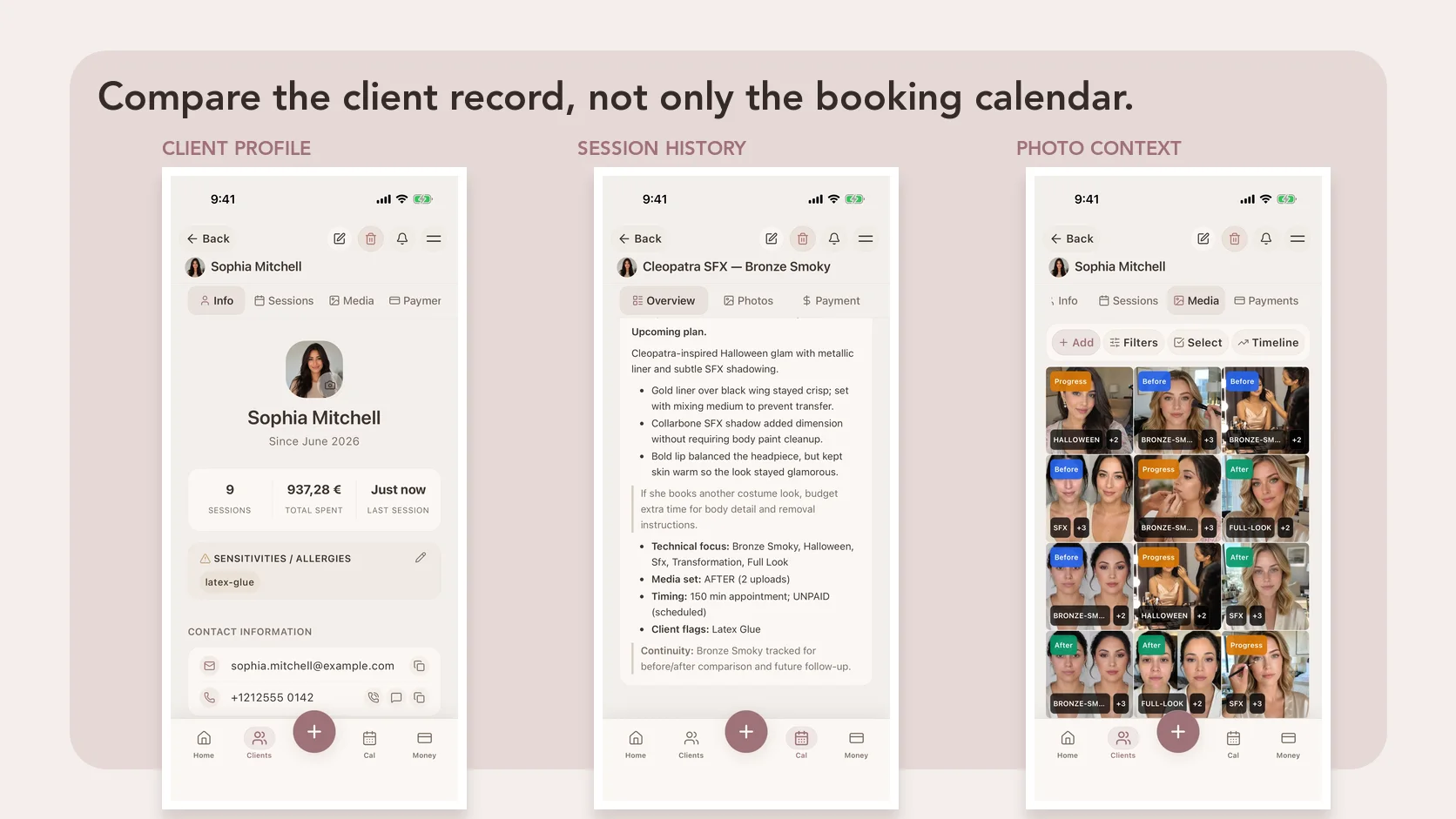
Best Makeup Artist Software in 2026: 6 Apps Compared
Compare six makeup artist software options for client records, bridal notes, products and shades, photos, forms, booking, deposits, offline access, and devices.
Read more
How Much Should I Charge for My First Bridal Makeup Job in 2026?
New bridal makeup artists: see U.S. starter rates of $150-$250 for the bride, plus trial, bridal party, travel, deposit, and quote examples.
Read more
Freelance Makeup Artist Client Management
See how Glamorph connects makeup bookings, trial notes, product shades, photos, signed forms and payments in one client-management workflow.
Read more