
Price hair color from the full appointment, not just the application time: blocked time x target hourly revenue, plus product used, plus approved extras.
This guide is for solo stylists, booth renters, mobile hairstylists, and freelance colorists who provide the service themselves and need prices that protect their time, product, and client experience.
Written by Konstantina Tsormpa, a bridal makeup artist and Glamorph founder. This is a pricing worksheet for beauty professionals, not a color-theory lesson or a claim that I personally provide hair-color services. It connects the calculation to the appointment and client records you can keep in Glamorph.
Hair color price = (full blocked time x target hourly revenue) + direct product cost + any agreed extras
The examples below use $75 per booked hour only to show the math. It is not a recommended national rate, and it may be too high or too low for your market.
Official wage data can give context, but it is not a freelance menu. The BLS Occupational Outlook Handbook lists the May 2024 median hourly wage for employed hairdressers, hairstylists, and cosmetologists at $16.95. A solo stylist’s price also has to cover product, overhead, admin time, no-shows, tax planning, and profit.
| Pricing part | What to include |
|---|---|
| Blocked time | Consultation, setup, mixing, application, processing oversight, rinsing, toner, finish, cleanup, notes, and payment |
| Product cost | Color, lightener, developer, toner, gloss, bond builder, treatments, foils, gloves, and other service-specific consumables |
| Client history | Length, density, regrowth, previous color, banding, home color, sensitivity notes, formulas, and how the hair lifted last time |
| Separate costs | Travel, parking, an assistant, patch-test appointment, or another clearly agreed cost when applicable |
Start With Your Target Hourly Revenue
Set your target hourly revenue before you look at another stylist’s menu.
That number is not the same as take-home pay. It also supports expenses that continue whether or not a client is sitting in your chair:
- Studio or booth rent
- Insurance and licensing
- Equipment replacement
- Laundry and cleaning
- Phone and internet
- Education
- Software
- Marketing
- Admin time
- Profit and reinvestment
If you already track supplies, rent, software, education, and travel as business expenses, your pricing review gets easier. Glamorph’s expense tracking can keep those costs attached to the same business record as your sessions and payments.
The US Small Business Administration’s break-even guidance separates fixed costs from the variable cost attached to each sale. Use the same split: hourly target supports the business. Product used for that client is added separately.
Use this formula:
Target hourly revenue = monthly owner compensation + fixed business costs + planned profit, divided by realistic billable hours
Here is a simple example.
| Monthly target | Example amount |
|---|---|
| Owner compensation | $4,200 |
| Fixed business costs | $1,200 |
| Profit and reinvestment | $600 |
| Total needed before variable product costs | $6,000 |
| Realistic billable hours per month | 80 |
| Target hourly revenue | $75 |
The important word is billable.
You might work far more than 80 hours in a month, but answering messages, ordering stock, cleaning, creating content, updating records, and handling gaps in your schedule are not always hours you can sell to a client.
Use your own monthly numbers, currency, tax situation, and realistic schedule. Confirm tax reserve or accounting decisions with a qualified professional in your location.
Once you know your floor, compare it with stylists serving a similar market. The SBA’s market research guidance recommends looking at what customers pay for alternatives.
Compare yourself with solo stylists who have similar experience, environment, and inclusions. A large salon with assistants, several chairs, and retail income may run on a different model.
Do the math first. Use the local market as context second.
Calculate Product Cost From What You Actually Use
Calculate product from actual grams or milliliters used, not a flat guess.
A guess such as “color costs me about $10” breaks when supplier prices rise or one client needs twice as much product as another.
Unit cost = amount paid for the container / usable amount in the container
Then calculate the cost used during the service:
Service product cost = unit cost x amount used
Here is an illustrative example. This is not a mixing guide. Always follow your own product line’s ratios and technical instructions.
| Product | Container cost | Amount used | Cost for this service |
|---|---|---|---|
| Color | $12 for 60 g | 30 g | $6.00 |
| Developer | $15 for 1,000 ml | 45 ml | $0.68 |
| Toner | $14 for 60 g | 20 g | $4.67 |
| Toner developer | $15 for 1,000 ml | 40 ml | $0.60 |
| Foils, gloves, and small consumables | Tracked average | - | $2.00 |
| Total direct product cost | $13.95 |
Use what you paid on your recent invoice, including delivery or purchase taxes when those materially affect your cost.
You do not need to show this calculation to every client. It is internal information that helps you create a clean, explainable public price.
When formulas vary by client, a dedicated hair color formula app and client history helps you compare what you planned with what you actually used.
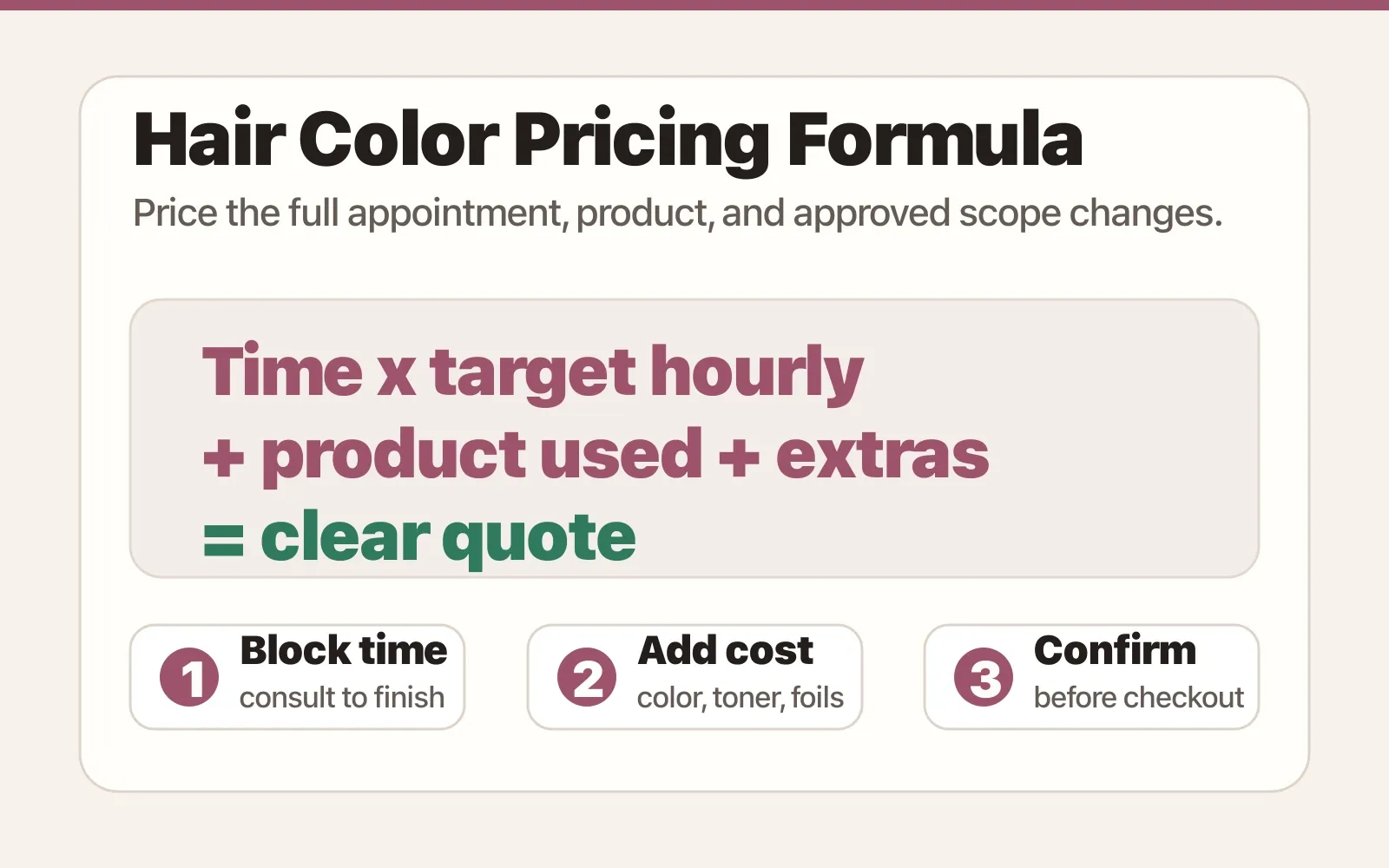
Keep the client-facing quote simple, but make the internal calculation specific.
Should Toner Be Included in the Color Price?
Toner can be included in your client-facing price without being free in your internal calculation.
If most versions of a service require one standard toner, include it in the starting price and cover it in your math. The menu stays simple.
When the toner varies significantly, you may need a starting price or a separate add-on. This can apply when the appointment needs:
- More than one toner formula
- A root shadow or root melt
- A separate gloss through the ends
- Extra product for long or dense hair
- Additional application and processing time
The client does not need a receipt listing every gram. They do need to know what the quote includes and what could change the total.
Avoid waiting until checkout to announce that toner cost extra.
Try the Hair Color Pricing Calculator
Use this calculator to test a quote before you publish it: blocked hours x hourly target, plus product, toner or gloss, and approved extras.
It is a planning tool, not tax advice or a universal price list. Use your own currency, supplier invoices, appointment timing, and market context.
Pricing calculator
Estimate a color-service quote
Adjust the appointment block, hourly target, product use, toner or gloss, and extras. The result rounds up to a clean client-facing quote.
3 x $75 + $18 + $10 + $0, rounded up to nearest $5.
Hair Color Service Pricing Examples
Use examples to test whether your pricing logic survives real appointment scenarios.
Every number is hypothetical. Replace the hourly target, appointment length, and product cost with your own records.
Root retouch using the same formula
$145
- Time
- 1 hr 45 min
- Product
- $11 color and consumables
- Toner
- Not included in this example
- Math
- 1.75 x $75 + $11 = $142.25, rounded up
Watch scope: Longer regrowth, dense hair, or a second mix may require more time and product.
Save for next time: Formula, grams used, amount of regrowth, and the return window you recommend.
All-over single-process color
$195
- Time
- 2 hr 15 min
- Product
- $22 color and consumables
- Toner
- Not included in this example
- Math
- 2.25 x $75 + $22 = $190.75, rounded up
Watch scope: Extra length, density, banding, or a major formula change alters the quote.
Save for next time: Length, density, formula, grams, fade, and the maintenance plan.
Partial highlight with toner
$255
- Time
- 3 hr
- Product
- $18 lightener and consumables
- Toner
- $10
- Math
- 3 x $75 + $18 + $10 = $253, rounded up
Watch scope: Extra bowls, dense sections, lowlights, or a root melt need additional time and product.
Save for next time: Placement pattern, lightener amount, lift, toner, and suggested next service.
Full highlight on long or dense hair
$380
- Time
- 4 hr 30 min
- Product
- $30 lightener and consumables
- Toner
- $12
- Math
- 4.5 x $75 + $30 + $12 = $379.50, rounded up
Watch scope: Previous banding, lowlights, a root shadow, or extra sections change the scope.
Save for next time: Sectioning, product use, lift, toner, and whether the next appointment can be a partial.
Balayage or foilyage with gloss
$340
- Time
- 4 hr
- Product
- $24 lightener and consumables
- Gloss
- $12
- Math
- 4 x $75 + $24 + $12 = $336, rounded up
Watch scope: Tip-out work, a root shadow, corrective sections, or multiple gloss formulas add scope.
Save for next time: Placement map, saturation, lightener, gloss, finish, and refresh plan.
First corrective-color session
$435+
- Time
- 5 hr provisional block
- Product
- $45 color or lightener
- Toner
- $15
- Math
- 5 x $75 + $45 + $15 = $435 starting estimate
Watch scope: Final scope depends on history, testing where appropriate, and what can realistically be completed.
Save for next time: Full history, consultation findings, first-session goal, result, and next-stage plan.
The rounded client price should be easy to quote. Your internal worksheet can keep the exact calculation.
These numbers do not mean a root retouch should cost $145 or a full highlight should cost $380. They show how one hypothetical stylist could reach those prices without guessing.
Let Client History Change the Quote
Let client history change the quote when it changes time, product, or risk.
Two clients can ask for “full highlights” and require completely different appointments. One may have predictable regrowth and a saved formula. Another may have home color, banding, fragile ends, and more product needs.
Before confirming the quote, check:
- Current length and density
- Amount of regrowth
- Natural level and current color
- Previous professional color
- Home color or other relevant color history
- Existing banding or uneven areas
- Previous formula and exact product use
- How the hair lifted during the last appointment
- Toner, gloss, or root formula used
- Whether extra bowls were needed
- Actual appointment duration
- What the client wants to achieve now
For a returning client, history makes the quote more accurate. It does not lock them into the same price forever.
A client who returns inside your recommended maintenance window may need predictable time and product. A client returning much later may need a larger application area, more product, or a different service. That is a change in scope, not a punishment.
For a first-time client with limited or uncertain history, give a starting estimate rather than pretending you know the final total from one photo.
Use Fixed Prices, Starting Prices, and Custom Quotes Differently
Use fixed prices for predictable services, starting prices for variable services, and custom quotes for uncertain history.
| Pricing style | Best used for | Example |
|---|---|---|
| Fixed price | A repeatable service with consistent time and product use | “Root retouch: $X. Includes the standard application and finish.” |
| Starting price | A service that changes with length, density, product use, or placement | “Partial highlights from $X, including one standard toner and finish.” |
| Custom quote | Corrections, transformations, or uncertain color history | “Corrective color requires a consultation before time and price can be confirmed.” |
A starting price should still mean something. Describe what the standard service includes, and do not publish a low starting price that almost no client qualifies for.
Message for a new color client
Use this when photos are helpful but not enough to confirm the final total.
Thanks for sending the photos. Based on your goal, [service] starts at [price]. The final quote depends on your current color, length, density, and previous color history. I will confirm everything with you at the consultation before I mix anything.
Message for a returning client whose appointment may need more work
Use this when the saved client history helps, but the scope may have changed.
I would love to see you again. Based on your last visit, your [service] starts at [price]. Since it has been [time], I may need [extra product, toner, or time]. I will confirm the full total with you before we begin.
Message when your public price has changed
Use this when a client is returning after your menu has been updated.
I would love to see you again. Just a heads-up, my current starting price for [service] is [price]. If that works for you, I can save [date/time].
You do not need to send a mass announcement to every previous client.
Update your public menu, booking information, and saved replies. Tell returning clients naturally when they ask to book again.
If you work with other professionals, Glamorph connects small-salon bookings, calendars and client history with separate member logins and role-based access. Each authorized stylist can review the previous service without sharing the owner’s account.
Keep already confirmed appointments at the agreed price unless a different arrangement was clearly discussed before booking.
Adjust every template to your own voice.
Price Color Corrections as a Plan
Price color corrections as planned sessions, not as a vague surcharge.
Corrective color should not cost more simply because the word sounds difficult. It should cost more when it requires more consultation, testing, time, product, formulas, documentation, or future sessions.
A correction estimate can include:
- Consultation and relevant color history
- Testing where appropriate to your training and product guidance
- The first session’s realistic goal
- Reserved appointment time
- Estimated lightener, color, toner, and treatment use
- What is included in the finish
- What would require another appointment
Use this calculation:
Correction estimate = consultation or testing + reserved time + estimated product + planned toner or treatment
Do not add an unexplained “correction fee” because the appointment feels stressful. Price the real work.
A correction quote might sound like this:
Based on the consultation, I expect the first session to take around [time] and start at [price]. That includes [scope]. Because we are working through previous color, I will confirm any change with you before I continue. I cannot promise the full result in one session, but I will explain what we can realistically work toward during this appointment.
This gives the client clarity without promising a result too early.
Track What Actually Happened After Every Appointment
Track the finished appointment so your next quote is based on evidence.
The original quote is only an estimate. The completed appointment shows whether the price worked.
After each color service, record:
- Service quoted
- Starting price
- Final amount paid
- Deposit and remaining balance
- Appointment start and finish time
- Formula
- Amount of each product used
- Toner or gloss
- Extra bowls or formulas
- Unexpected corrective work
- Result photos
- What took longer than expected
- Recommended next service
- Rebooking notes
Then calculate:
Amount left after direct product per blocked hour = (final amount paid - direct product cost) / total blocked time
For the partial-highlight example:
| Item | Amount |
|---|---|
| Final amount paid | $255 |
| Direct product cost | -$28 |
| Amount left before fixed overhead and tax | $227 |
| Total blocked time | 3 hours |
| Amount per blocked hour | $75.67 |
That appointment is close to the hypothetical $75 target.
When a service repeatedly falls below your target, find the reason before raising the price.
The problem may be:
- The appointment takes longer than your menu allows
- Product use is higher than you estimated
- Toner or a root melt is being included without being priced
- The service description includes too much
- The consultation did not reveal the real scope
- Your fixed business costs have changed
- Your target no longer supports the income you need
The SBA also recommends keeping clear revenue and expense records as part of basic small-business financial management.
Use a notebook, spreadsheet, or client-management app. What matters is comparing what you expected with what actually happened.
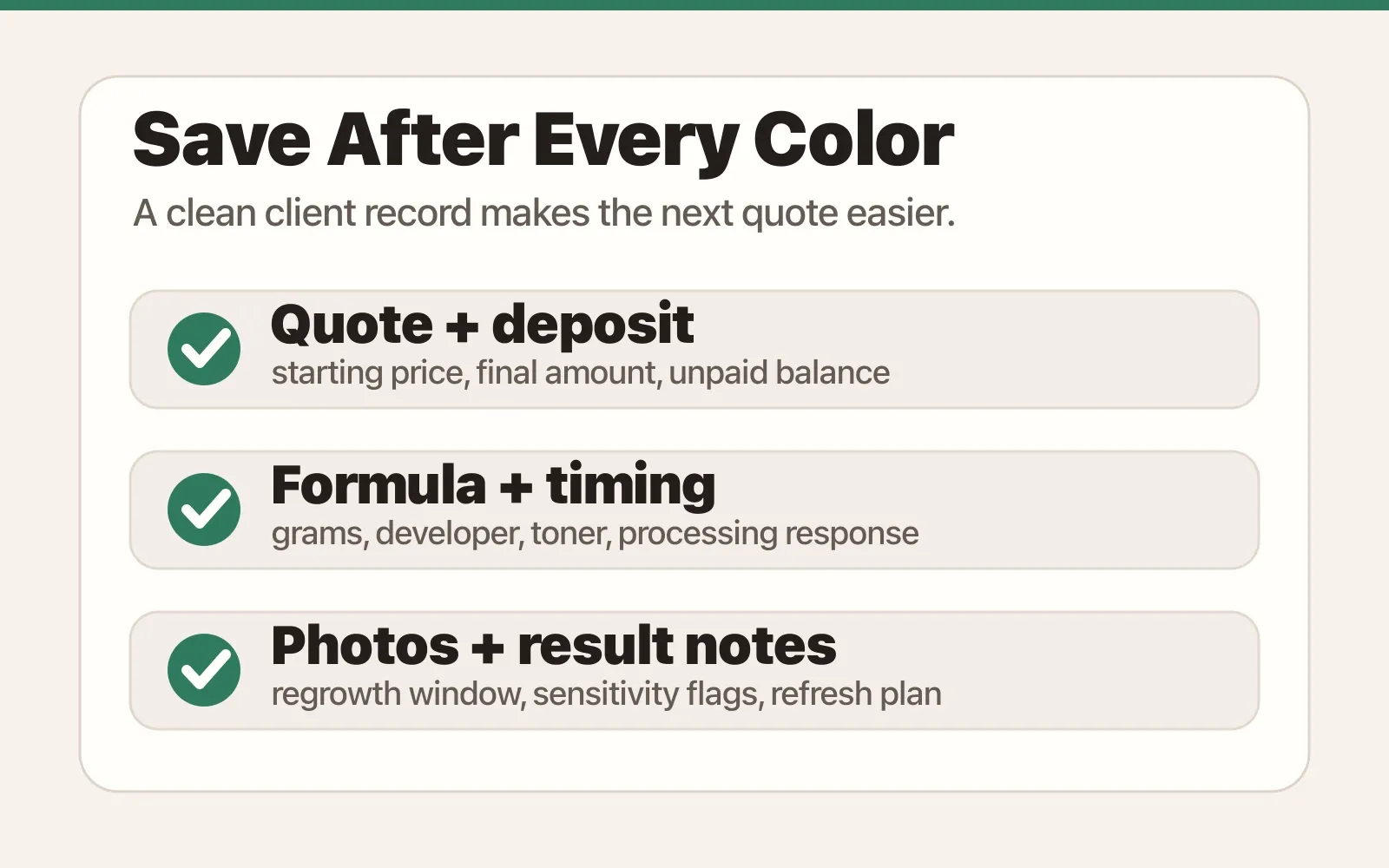
Client history is not just admin. It gives you evidence for the next quote.
Glamorph connects booking, client records and checkout for solo hairstylists and small salons. Its session tracking keeps your recorded formula, timing, photos and result with the appointment. These are details you enter, not automatic weighing, stock deduction or color-cost calculation.
With Glamorph payments, connect Stripe, SumUp or Square to collect a deposit or the final balance. Use a payment link, supported phone payment method or a paired SumUp Solo or Square Terminal. Confirmed payments stay with the client history. Methods and processing fees depend on your business country, account, provider and device. Cash and external payments can also be recorded manually.
For a returning client, you can also save a card with their permission in the web app. At the next checkout, select an eligible saved card, review the service amount and any tip, then confirm the charge. The card stays with the provider account that saved it. Saving it does not authorize every future charge.
If photos affect the next quote, searchable before-and-after photo tags help you find the exact balayage, gloss, correction, or result photo without digging through your camera roll. Any software subscription belongs in overhead too. Glamorph’s pricing is public, so you can include the real monthly cost in your numbers.
Common Hair Color Pricing Mistakes
Most pricing problems come from undercounting time, undercounting product, or surprising the client too late.
| Mistake | Better approach |
|---|---|
| Copying another stylist’s menu before doing your own math | Calculate your floor first, then use local prices as context |
| Counting only application time | Count the full time the appointment occupies in your schedule |
| Treating toner as free | Include its product and application time, even when it is bundled |
| Using one permanent product-cost estimate | Update costs from invoices and actual usage |
| Giving every client the same quote | Check length, density, regrowth, goals, and previous color |
| Adding surprise product charges at checkout | Explain the standard inclusion and approve extra scope beforehand |
| Pricing corrections as a normal fixed menu service | Consult first and quote the planned session |
| Failing to record actual time and product | Review completed appointments and adjust from evidence |
| Raising the price of an already confirmed appointment | Keep the agreed price unless another rule was clearly discussed |
Frequently Asked Questions
Use the same pricing logic in every answer: time, product, scope, and client history.
How much should I charge for hair color?
Start with your own floor: full blocked time x target hourly revenue, plus direct product cost and agreed extras.
Then compare that number with local stylists serving a similar market. If your calculated price is much lower, you may be underpricing. If it is much higher, check whether your service includes more time, product, experience, location convenience, or corrective work.
Should processing time count toward the price?
Yes, count processing time when the client occupies your chair and you are responsible for the result.
When the client occupies your only chair and you monitor the service, processing time is part of the appointment.
When you consistently and appropriately provide another compatible service during processing, do not treat the same minute as fully unavailable twice. Allocate time according to how you really work rather than using an automatic rule.
Should I charge per bowl of color?
Track bowls internally, but keep the client-facing price clear.
You might include a standard product allowance in the starting price and explain that unusually high product use changes the quote. Another option is to build average product use into different length or service categories.
The important part is approval. Do not mix several additional bowls and reveal the cost only at checkout.
Should returning clients pay less?
Not automatically. Returning clients should pay for the time, product, and scope of the current appointment.
A returning client may be easier to quote because you know the formula, placement, processing response, and usual product use. That history reduces uncertainty, but the service still uses time and product.
A loyalty benefit is fine if you choose it deliberately. It should not happen because you feel uncomfortable charging your current price.
When should I review my color prices?
Review prices whenever real appointments show that the current price no longer covers the time and product involved.
Also review when:
- Supplier prices rise
- Rent or overhead changes
- Your service now includes more
- Your appointment timing changes
- You invest in additional education or equipment
- Demand regularly fills your available schedule
- A service repeatedly misses your hourly target
Use completed appointments, not only feelings, to decide what changes.
Do clients need to see my full pricing calculation?
No. Clients need a clear price, useful starting point, list of inclusions, and explanation of what could change the total.
Your hourly target, monthly overhead, and product worksheet are internal business information.
Hair Color Pricing Checklist
Before publishing a color price, check the math, the scope, and the client communication.
- Did I calculate a realistic hourly revenue target?
- Did I count the full blocked appointment time?
- Did I include the finish if it is part of the service?
- Did I calculate actual color, developer, lightener, and toner cost?
- Did I account for client length, density, regrowth, and history?
- Is the public price fixed, starting, or consultation-based for a clear reason?
- Does the client know what the standard service includes?
- Will I approve extra time or product before continuing?
- Am I recording actual time, product use, payment, and rebooking notes?
- Did I compare my calculated price with relevant local alternatives?
Good pricing should feel explainable.
You should be able to point to time, product, and service scope, not a random fee or the number another stylist happened to post.
Written by

Professional makeup artist and founder of Glamorph
Makeup artist and Glamorph founder with 5+ years of experience. Working closely with professionals across the beauty industry, she writes about client management, booking and everyday salon workflows.
You might also like
How Much Should I Charge for My First Bridal Makeup Job in 2026?
New bridal makeup artists: see U.S. starter rates of $150-$250 for the bride, plus trial, bridal party, travel, deposit, and quote examples.
Read more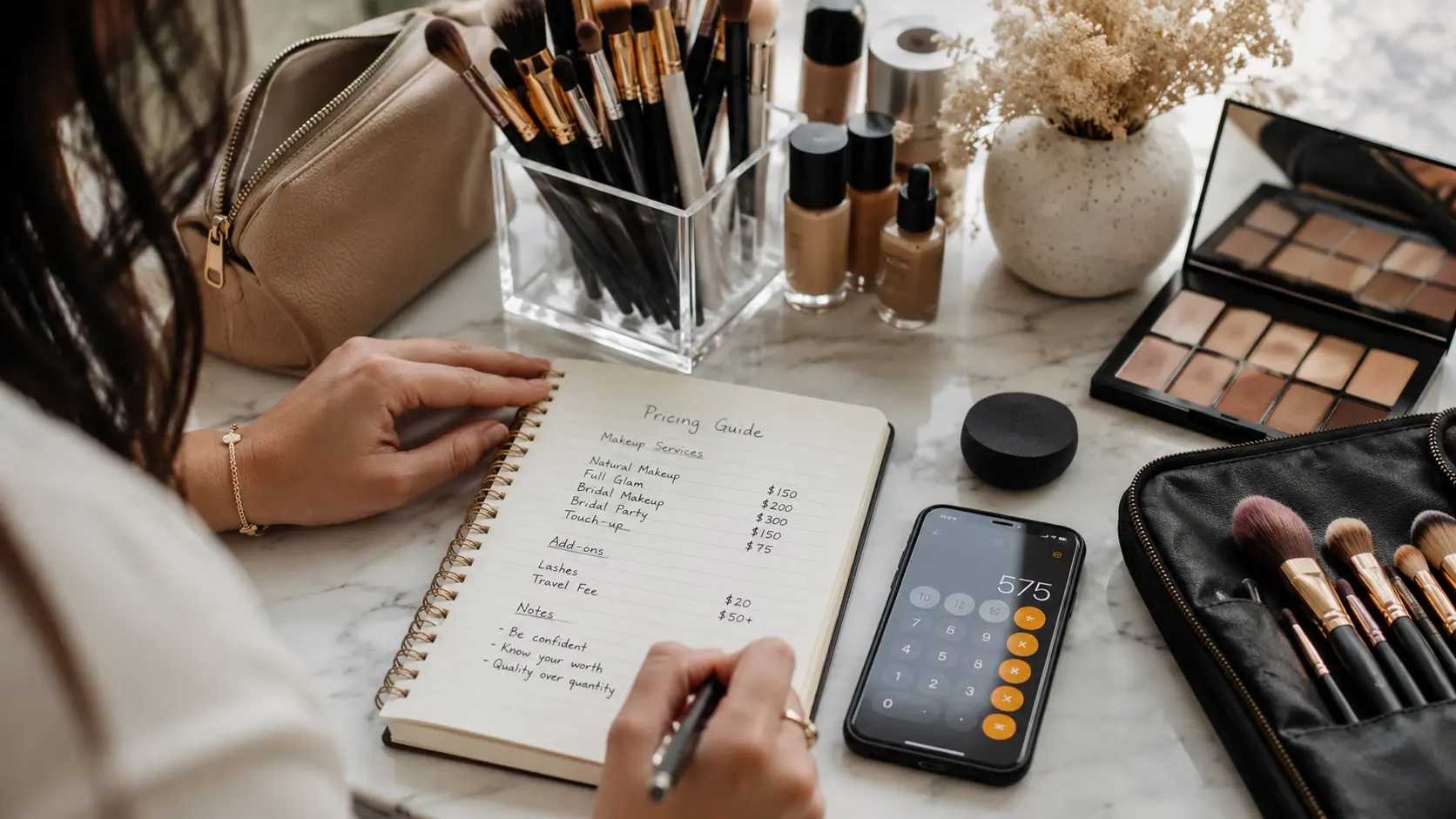
How Much Should Beginner Makeup Artists Charge in 2026?
Beginner makeup artists often charge $60–$100 for event makeup and $120–$250+ for bridal. Compare rates, travel fees, deposits, and real booking profit.
Read more
Best Booking Software for Lash and Brow Artists
Compare Glamorph, GlossGenius and Vagaro for lash and brow bookings, deposits, consultation forms and returning-client history, solo or with a small team.
Read more