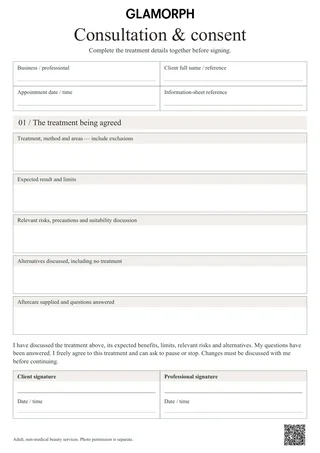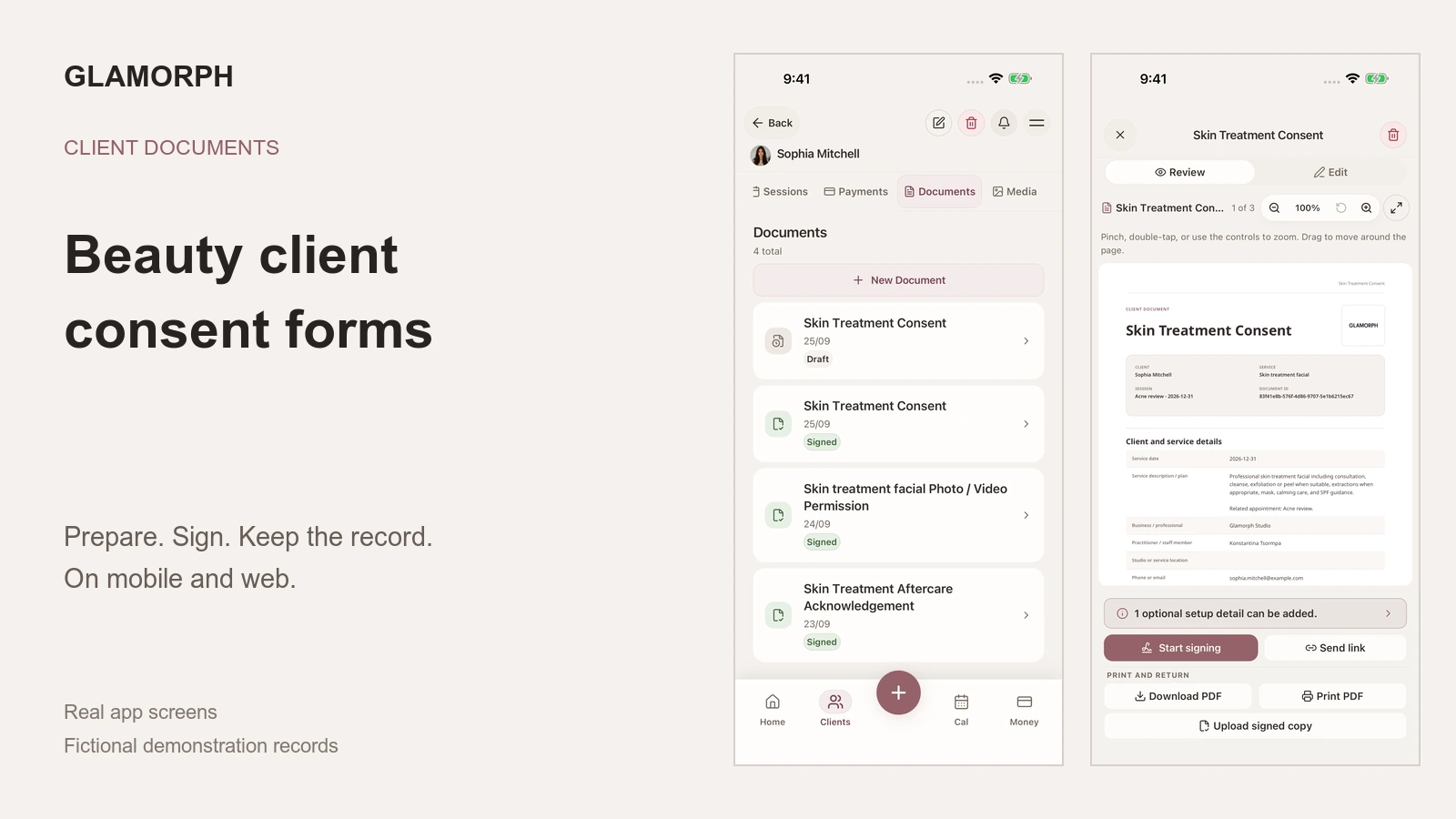
A beauty client consent form should identify the client and service, collect only relevant consultation details, explain what the client is agreeing to, record any questions or changes, and include the name, date, signature, and document version. Keep patch-test records, photo permission, and aftercare separate when they serve a different purpose.
This guide is for solo beauty professionals and small teams. I am writing as a working makeup artist and Glamorph founder, not as a lawyer. Your exact forms should follow the rules, insurer requirements, product instructions, and professional standards that apply to your services and location.
Beauty consent form checklist
Use this table to decide which record you need before adapting any template. It is a practical structure, not a universal legal form: the wording and required fields depend on the service and where you work.
| Record | What it is for | Usually completed |
|---|---|---|
| Consultation or intake form | Client details, goals, relevant history, sensitivities, and questions before the service | Before the first appointment and when important details change |
| Service consent form | The planned service, important limitations or risks, client questions, and agreement to proceed | Before the relevant service |
| Patch-test record | Product tested, date, area, instructions, reported or observed result, and decision | Whenever your protocol requires a test |
| Photo and video release | Permission to capture or use images for specific purposes | Before taking or publishing images for that purpose |
| Aftercare instructions | What the client should do or avoid after the service | At or after the appointment |
| Aftercare acknowledgement | Confirmation that instructions were received and discussed | When appropriate for the service |
| Session record | What you actually did, products used, result, photos, and next-visit notes | Immediately after the appointment |
The recurring problems are practical: forms sent too late, copied generic wording, pages clients skim, records that disappear into paper files or email, and photo permission nobody can confirm later. The simplest system uses a short service-specific form, sends it early, reviews the answers before the appointment, preserves the completed version, and keeps it with the client history.
Is a consultation form the same as a consent form?
No. A consultation form collects information; a consent form records an informed decision about a specific service.
They can appear in one document, but the sections should still be easy to tell apart.
| Consultation asks | Consent explains and records |
|---|---|
| What result does the client want? | What service is planned? |
| Has she had this service before? | What should she understand before deciding? |
| Has she mentioned a relevant sensitivity or previous reaction? | Were her questions answered? |
| What products, treatments, or recent changes are relevant to this service? | Does she agree to proceed with this service? |
| What would make the appointment more comfortable? | Who agreed, when, and for which version of the document? |
From my side as a makeup artist, this distinction matters. “I like soft glam” belongs in consultation notes. “We discussed the planned application, products around the eye area, lash adhesive if used, wear expectations, and removal guidance” belongs in the service-consent conversation.
A signature should confirm a conversation and a specific document. It should not replace the conversation.
What should a beauty client consultation form include?
Start with only the information you genuinely need to prepare for the appointment, provide the service, communicate with the client, and keep an accurate record.
1. Client and appointment details
- Full name
- Reliable contact method
- Appointment date and service
- Professional providing the service, if more than one person works in the business
- Parent or guardian details only when they are actually required
Do not collect extra identity information “just in case.” If you work in the EU, the European Commission’s GDPR guidance on data minimisation says personal data should be limited to what is necessary for the stated purpose.
2. The client’s goal and expectations
Ask what the client wants in her own words.
Useful prompts can include:
- What result are you hoping for today?
- Is there anything you definitely do not want?
- Have you had this service before?
- Is there a previous result, reference image, shape, shade, or style you want me to see?
- Is this for an event, wedding, photoshoot, holiday, or ordinary repeat appointment?
This is not filler. It gives you something specific to confirm before you start and something useful to compare with the final result.
3. Relevant history, allergies, and sensitivities
Ask questions that are relevant to the service you actually provide. Avoid copying a medical questionnaire designed for a different treatment.
For example, a makeup artist may need to ask about known cosmetic or adhesive sensitivities and recent reactions around the eyes. A colorist may need relevant color history and the results of testing required by the product or salon protocol. A lash artist may need previous adhesive reactions and current eye-area irritation.
Write what the client tells you without turning the note into a diagnosis.
| Too vague | More useful record |
|---|---|
| “Allergic” | “Client reports a previous reaction to [product or ingredient, if known]. Do not use until reviewed.” |
| “Sensitive eyes” | “Eyes watered during previous strip-lash application. Discuss adhesive and placement before starting.” |
| “Bad reaction before” | “Client reports redness after her last tint. Date and product unknown. Stop and follow the relevant testing or referral protocol.” |
For skin professionals, the Associated Skin Care Professionals recommends documenting consultation details, the treatment plan, products used, and post-service notes in the client record. Its esthetician client-record guidance also makes a practical point: update the record while the appointment details are still fresh.
The full esthetician client-record field map shows where intake and consent end and the before, during, after, photo, and follow-up record begins.
4. Service plan and important explanations
Name the service clearly. Then record the points the client should understand before choosing to continue.
Depending on the service and local requirements, this may include:
- What you plan to do
- The area or result being worked on
- Reasonable limitations and what you cannot promise
- Relevant discomfort, irritation, maintenance, or result variability
- When the service should be postponed or not performed
- What the client should tell you before you begin
- Space for questions and changes to the plan
Do not paste every possible risk from every beauty treatment into one frightening paragraph. A service-specific form is easier to understand and easier to defend editorially than a universal wall of text.
5. Clear agreement, name, date, and signature
The client should be able to see exactly what she is agreeing to. Keep the consent statement close to the signature instead of hiding it several screens away.
Record:
- Client or guardian name, where applicable
- Professional name, if your workflow requires it
- Date and time
- Signature or another appropriate affirmative action
- Document title and version
- Service or appointment the document relates to
A digital signature does not fix unsuitable wording. It records an action against the document shown to the client. In the EU, eIDAS distinguishes simple, advanced, and qualified electronic signatures; the European Commission explains that only qualified electronic signatures are automatically equivalent to handwritten signatures across the EU. Check whether a regulated service or a particular document needs a specific signature level in your country.
Which details change by beauty profession?
The best form follows the service, not a generic “salon client” label.
| Profession or service | Consultation details that may be useful | Separate record to consider |
|---|---|---|
| Makeup and bridal makeup | Skin-prep preferences, known cosmetic or adhesive sensitivities, eye comfort, desired finish, inspiration, event timing | Photo permission, trial-to-wedding changes, aftercare or removal guidance |
| Hair color | Relevant color history, current result, goal, previous reactions, products or services that affect the plan | Allergy-alert or patch-test record, strand-test record, formula and result note |
| Lash services | Previous extensions or lifts, reported reactions, eye-area comfort, desired curl, length, fullness, and maintenance expectations | Patch-test record when required, service consent, aftercare acknowledgement |
| Brow services | Desired shape or tint, previous brow services, relevant skin sensitivity, recent products or services that affect the area | Patch-test record when required, photo permission, aftercare |
| Nail services | Current nail and surrounding-skin condition, previous product reactions, enhancement history, preferred shape and length | Product/system note, repair or removal record, aftercare |
| Esthetics and waxing | Service goal, relevant skin history disclosed by the client, recent products or treatments that affect suitability, area to be treated | Treatment-specific consent, progress-photo permission, aftercare |
| Spray tan | Desired result, reported product sensitivities, skin preparation, clothing and timing expectations | Service consent and aftercare instructions |
If you provide several services, do not force every client through every question. Someone booking event makeup does not need to answer a hair-color questionnaire.
This is why the workflows for esthetician client management, lash artist client records, and makeup artist client management should share a client profile but keep service-specific details separate.
What belongs in a patch-test record?
A patch-test record is evidence of what was tested and what happened. It is not a checkbox that automatically makes every later service suitable.
Record the information required by the relevant manufacturer, professional protocol, insurer, or local rule. A practical record may include:
- Product and shade or variant tested
- Batch or lot number when your protocol requires it
- Test area
- Date and time applied
- Who applied it or whether the client followed approved at-home instructions
- Instructions given
- Reported or observed result
- Date and time the result was checked
- Decision and next step
- Client and professional confirmation where required
Testing schedules are not universal. The UK’s National Hair & Beauty Federation tells salons to follow its allergy-alert system and the manufacturer’s protocol, keep written records, and obtain the client’s signature. Its allergy-alert testing guidance is a useful industry example, not a rule for every product or country.
Never write “patch test passed, therefore no reaction is possible.” Record the result you had and continue to follow the instructions that apply to the service.
Should photo consent be separate?
Yes. Keep permission to provide a service separate from permission to use a client’s face, body, or treatment-area photos for marketing.
A client may agree to private progress photos in her record and say no to Instagram. She may allow a cropped close-up but not a full-face image. Those choices should not be buried inside a mandatory service waiver.
A practical photo and video release should let the client understand:
- Whether you may capture photos, video, or both
- Whether the media stays private in the client record
- Whether it may appear in a portfolio, website, social media, email, print, paid advertising, or education
- Whether her name or another identifying detail will appear
- Whether permission covers before, progress, and after images
- How she can ask questions or withdraw future permission where applicable
- Whether refusing marketing use affects the service. It normally should not.
The UK’s Information Commissioner’s Office says valid consent must be freely given, specific, informed, and unambiguous, with a genuine ability to refuse or withdraw it. Its valid-consent guidance is useful when designing optional photo-use choices, even if your business is outside the UK and needs different legal review.
Keep the permission status beside the photos. A folder full of beautiful before-and-after images is not useful if you cannot tell which ones are private and which ones may be published. Glamorph’s before-and-after photo workflow keeps photos attached to the relevant client and session; the permission itself should still be clear and specific.
How often should clients complete or update forms?
There is no honest universal answer such as “once per year” for every beauty service.
Review the form when:
- The client is new
- The requested service changes
- The product, protocol, or important wording changes
- A previous form or test has expired under the rule you follow
- The client reports a new sensitivity, reaction, medication, pregnancy, procedure, or other relevant change
- A returning client says something is different
- Your insurer, licensing body, manufacturer, or local authority requires a new record
Use a short day-of question even when a current form already exists:
Before we start, has anything changed since the form you completed, especially any new reaction, sensitivity, product, treatment, or detail that could affect today’s service?
If the answer changes the service, update the record before continuing. Do not edit an old signed document so it looks as if the new information was there from the beginning. Create a new version or an additional dated record.
Is paper or digital better for beauty consent forms?
Either can work. The better system is the one that lets the client read the form, lets you review it before the service, protects the information, and lets you retrieve the exact signed version later.
| Paper forms | Digital forms |
|---|---|
| Familiar and easy to point through together | Can be sent before the appointment |
| Can work without a device or account | Easier to search and connect to a client record |
| Need secure physical storage | Need appropriate access controls and data handling |
| Handwriting may be difficult to read | Required fields can reduce accidentally skipped answers |
| Updating a template does not update old copies | Versioning can preserve what the client actually signed |
| Harder to connect with session photos and notes | Can sit beside sessions, photos, and service history |
Do not choose digital only because it looks modern. Choose it if it makes the workflow clearer.

The useful part is not the tablet. It is being able to find the exact finalized record beside the client history.
A simple digital consent workflow
This is the workflow I would use for a solo beauty business:
- Choose the right document. Start with a service-specific consultation, consent, patch-test, photo-release, or aftercare record.
- Review the wording. Remove irrelevant questions and have important legal or treatment wording reviewed for your location.
- Send it early when possible. Let the client read and complete the form before the appointment instead of using her service time for paperwork.
- Check it before you start. Do not collect a form and then ignore the answers.
- Confirm changes in person. Ask whether anything relevant has changed and discuss the planned service.
- Collect the required confirmation. Sign in person or through the appropriate online process.
- Freeze the completed version. Keep the exact content, signature details, and timestamp rather than overwriting the record later.
- Complete the client history. Keep the form with the relevant client and session, then record what you actually did, the result, aftercare provided, and what to review next time.
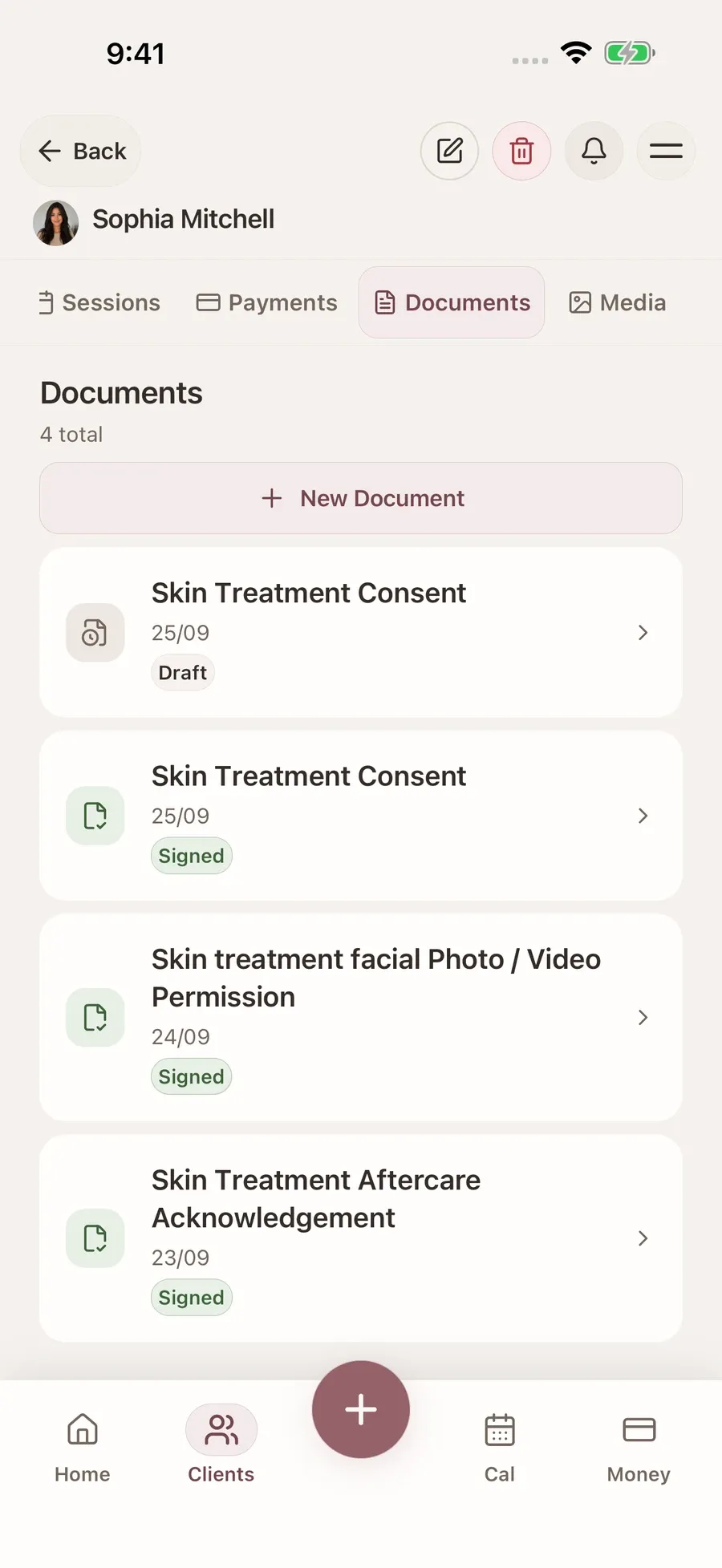
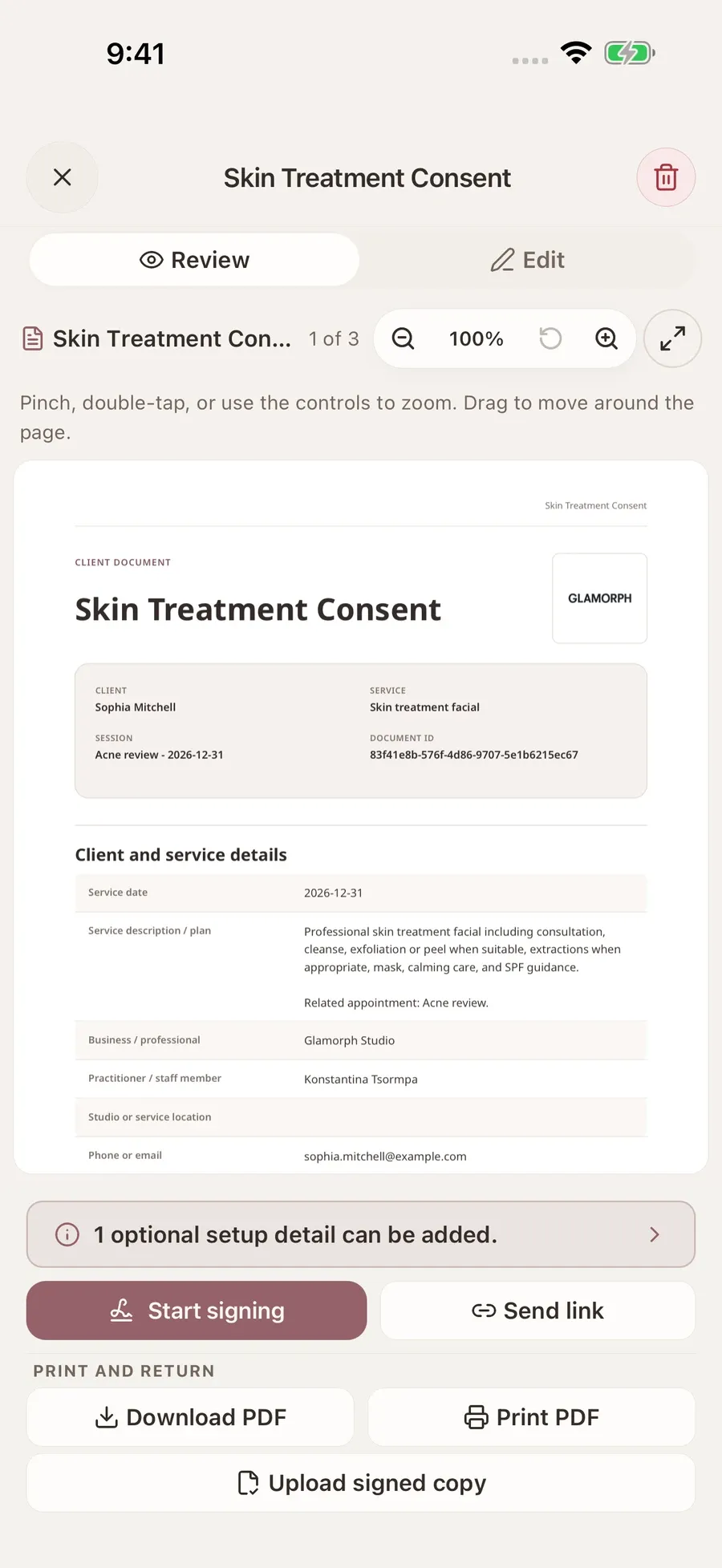
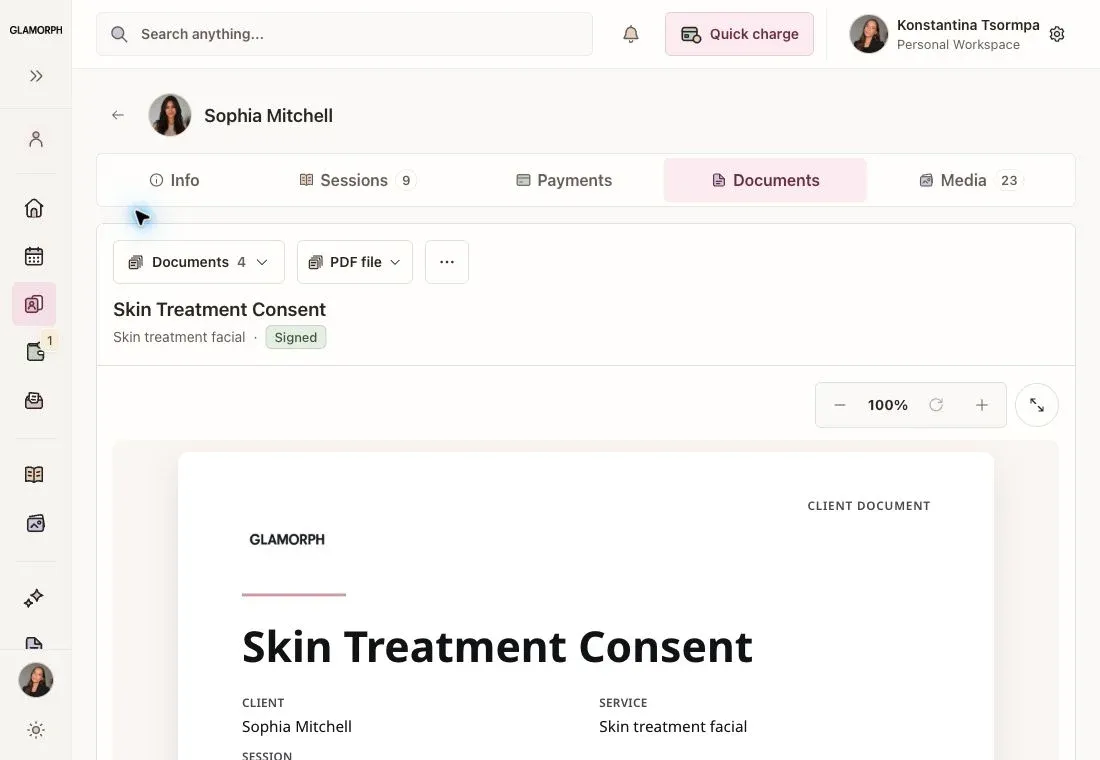
This is the part Glamorph can help organise. Its digital consent forms for beauty professionals let you start from beauty-service documents, adjust them for your work, collect a signature in person or through a link, and keep the completed PDF with the client or session record.
The document does not replace your judgement, consultation, insurer, or local requirements. It makes the record easier to prepare, complete, and find.
How should beauty client forms be stored?
Store forms so authorised people can find the right record and unauthorised people cannot casually access it.
For an EU beauty business, a practical privacy review should cover:
- Purpose: Why are you collecting each field?
- Minimum data: Is every question necessary for that service?
- Transparency: Have you told the client who you are, why you use the information, and how long you plan to keep it?
- Accuracy: Can relevant changes be recorded without rewriting history?
- Retention: When will you review or delete records that are no longer needed?
- Security: Who can open, export, print, or share them?
- Client rights: How will you respond to a valid access, correction, restriction, or deletion request?
The European Commission’s data-protection overview confirms that GDPR principles apply regardless of whether organised personal data is stored in software or on paper.
Do not copy a retention period from a salon in another country. Your period may depend on local law, tax or insurance needs, licensing, the client’s age, and the kind of service. Write down the rule you actually follow and review it with an appropriate professional.
Final checklist before you use a form
Before sending a beauty client form, ask:
- Does the title name the real service or purpose?
- Can the client tell consultation questions from consent statements?
- Have I removed questions that are irrelevant to this service?
- Does the form explain the planned service clearly?
- Are optional photo and marketing choices separate?
- Is there room for the client’s questions and relevant changes?
- Can I tell which version was signed and when?
- Will I review the answers before starting?
- Can I find this record beside the correct client and appointment later?
- Have I checked local law, licensing, insurer, and manufacturer requirements?
If you cannot answer the final question yet, keep the form as a draft. A polished template is not a substitute for correct local review. A structured beauty client-management system can help keep the approved form beside the relevant client and appointment instead of leaving it in an inbox or unrelated folder.
FAQ
Do all beauty professionals legally need consent forms?
Requirements vary by country, local authority, licence, insurer, service, product, and client age. Some services or locations require specific records; others treat forms as professional good practice. Check the rules that apply to your actual work instead of relying on a generic article or downloaded waiver.
Can one consultation form cover every future appointment?
Usually not safely. Stable profile information can be reused, but a new service, changed circumstances, updated wording, expired test, or relevant client change may require a new or updated record. Confirm changes before every appointment.
Can a client sign a beauty consent form online?
In Glamorph, a client can sign on your device or through a remote signing link. Whether that method is appropriate for your particular service or document depends on local requirements. In the EU, do not describe every drawn digital signature as a qualified electronic signature.
How long should I keep beauty consent forms?
There is no universal retention period. Set one using the legal, insurance, licensing, tax, and service requirements that apply to your location. Under GDPR, personal data should not be kept longer than necessary for its stated purpose.
Is a photo release part of a treatment consent form?
It can be delivered in the same workflow, but the choice should be separate. A client should be able to consent to the service without automatically consenting to public marketing use of her photos.
Does a signed consent form remove the professional’s responsibility?
No. A signature records what was presented and agreed to; it does not make an unsuitable service safe, cure misleading wording, replace a consultation, or remove your professional duties.
Written by

Professional makeup artist, bridal MUA, and founder of Glamorph
Professional makeup artist and bridal MUA with 5+ years of experience, founder of Glamorph, writing about bridal beauty, soft glam, and freelance beauty work.
You might also like

Esthetician Client Records: What to Track Before, During and After Every Treatment
A practical esthetician client-record field map for intake, consent, treatment notes, products, sensitivities, photos, aftercare, and follow-up.
Read more
How to Organize Before-and-After Client Photos
Organize beauty client photos by client, session, before/progress/after stage, service, and permission so you can find past work without scrolling.
Read more
Freelance Makeup Artist Client Management
A practical client management workflow for freelance makeup artists to organize client notes, skin details, products, photos, payments, and bridal history.
Read more