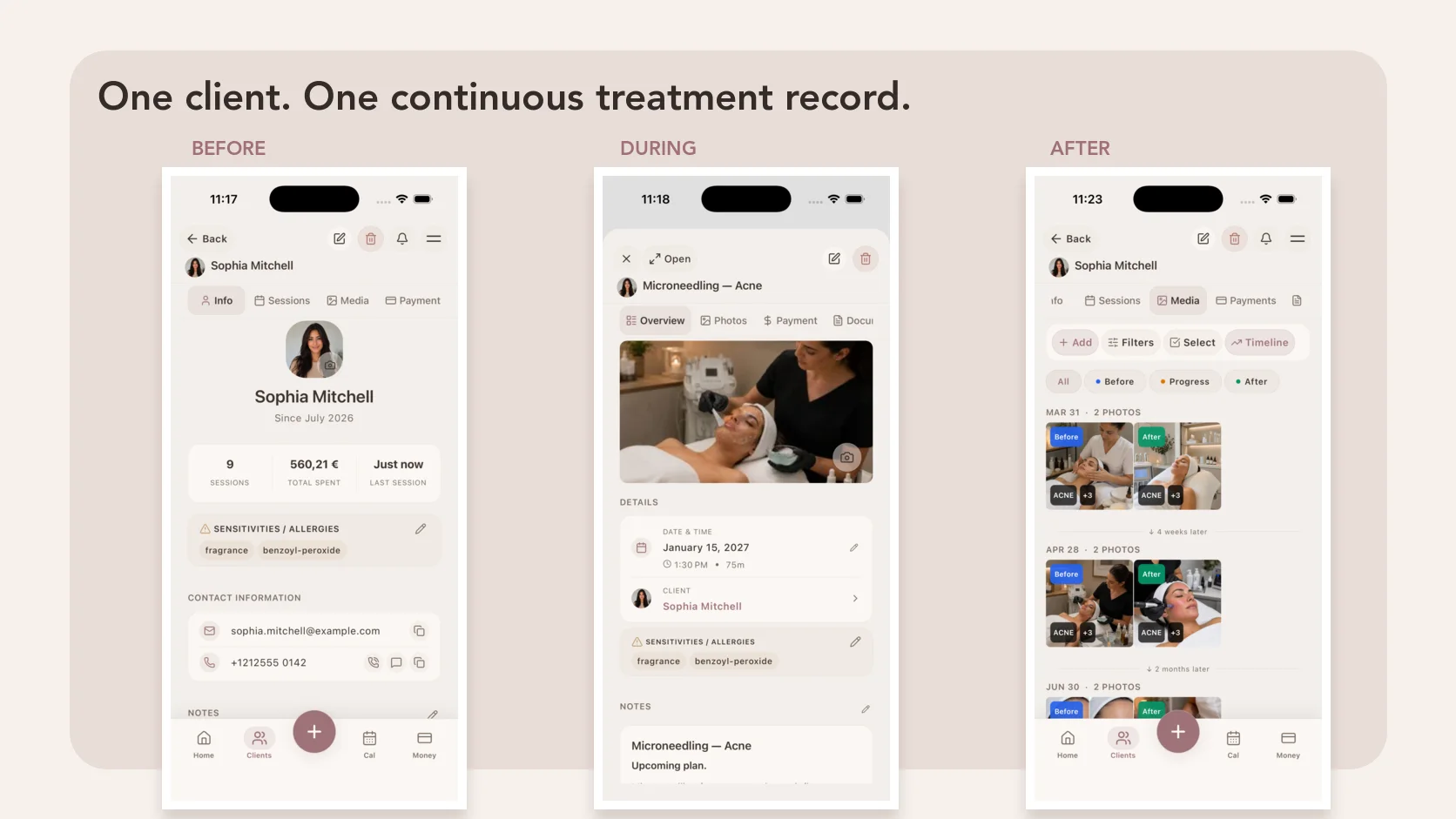
An esthetician client record should separate information that stays relevant across visits from what happened at one treatment. Before the service, record the client’s goal, relevant history, reported allergies or sensitivities, intake, consent, and photo choice. During it, record the service, products, parameters, observations, and changes. After it, add the result, photos, aftercare, client feedback, payment status, follow-up, and next plan.
In Glamorph, the client profile holds lasting preferences, while each session keeps its own treatment notes, photos, documents and payments. Online bookings connect to the same history, and small teams can give each professional access through their own login and role. You can start with records and documents without publishing a booking page.
This guide is for solo estheticians, facialists, and small non-medical beauty teams. It is a practical recordkeeping workflow, not a treatment protocol, legal form, or electronic medical record. Use the licensing, insurance, manufacturer, privacy, and retention requirements that apply to your services and location.
Choose a client-record PDF
Use the two-page form for a general client profile and visit record. Choose the facial workbook when you need a face-and-neck map, more product detail or a separate follow-up sheet. Both files can be filled in a compatible PDF reader or printed. Use only the pages needed for the appointment.
Client profile and treatment record
2 pages · A4 · Fillable PDF · No account required
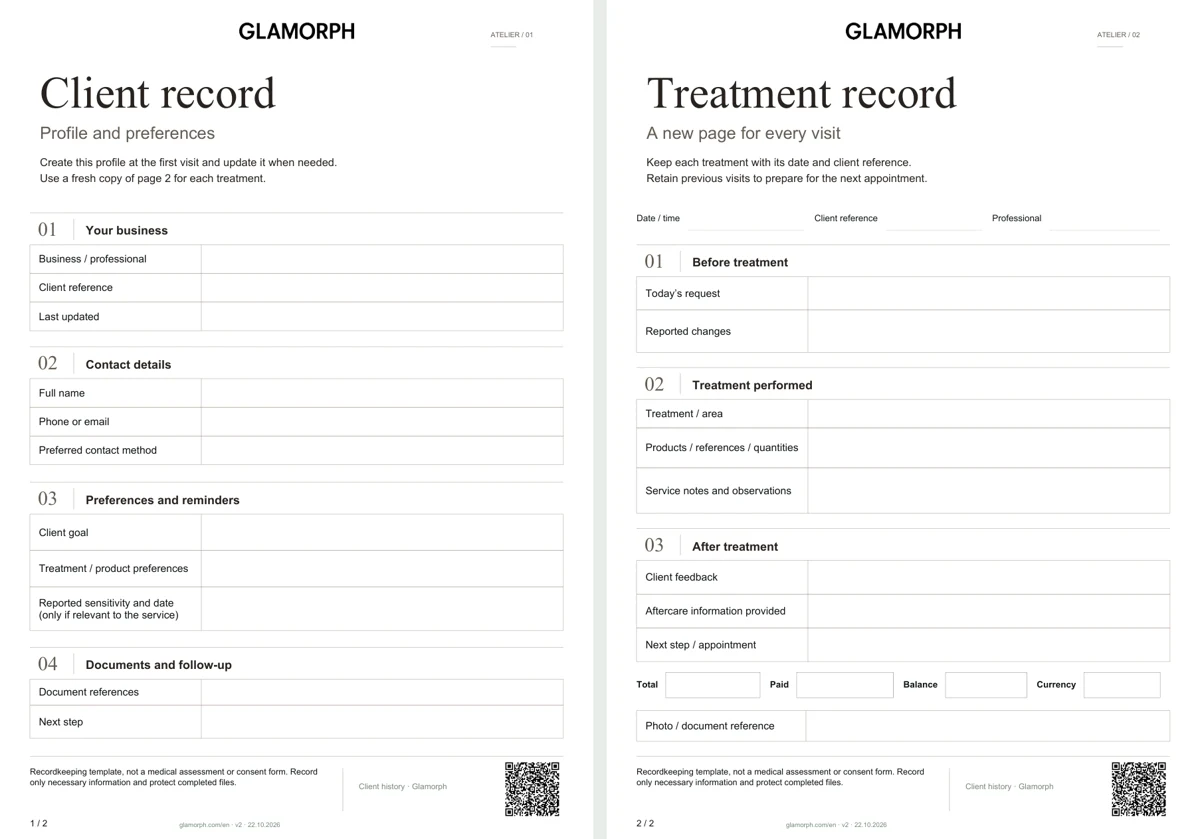
The first page holds contact details, preferences and references to separate documents. Use a fresh second page for every treatment: what was requested, what you used, observations, feedback and the next step.
Type into the fields using a compatible PDF reader, or print on A4 at 100%. Keep the blank original, save each completed copy under a new name, and reopen it to check that the text was retained. Payment fields are optional and include a currency field. They are not an invoice. The PDF does not submit client information to this website.
This is a recordkeeping template, not a medical assessment or consent form. Keep service consent and photo-use permission in their own documents and reference them where appropriate. Adding the PDF to Glamorph’s client documents keeps the file with the client. It does not automatically convert its fields into structured app records.
Facial treatment map and service record
| Page | When it helps |
|---|---|
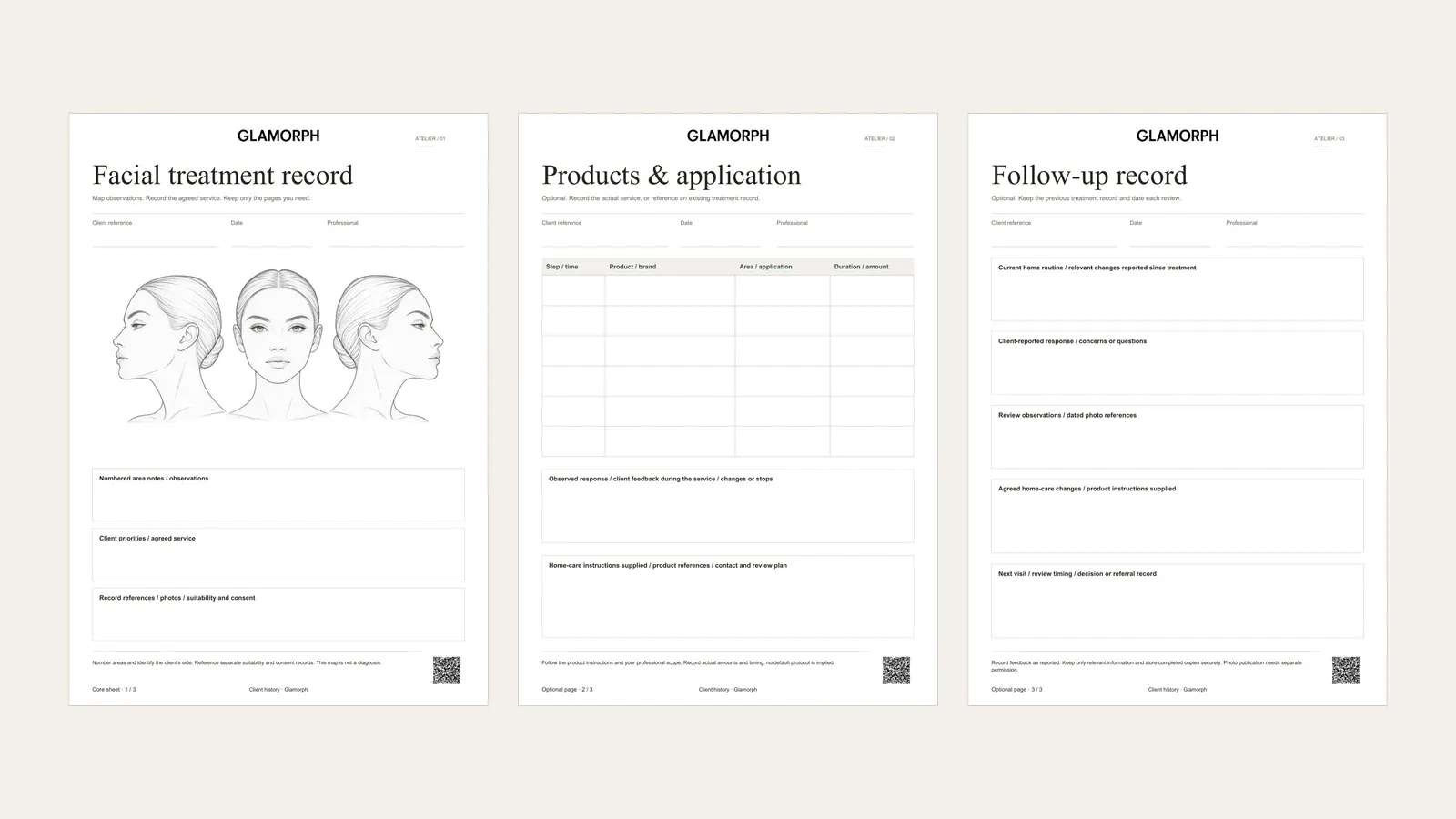
| 1. Facial treatment record | Mark areas on frontal and profile views, then connect numbered observations to the client’s priorities and agreed service |
| 2. Products and application | Record the actual products, areas, timing or amounts, response during the service and instructions supplied |
| 3. Follow-up record | Add reported routine changes, client feedback, review observations and the next agreed step without rewriting the original visit |
The product and follow-up pages are optional. If your existing session record already contains the same information, reference it rather than maintaining two competing records.
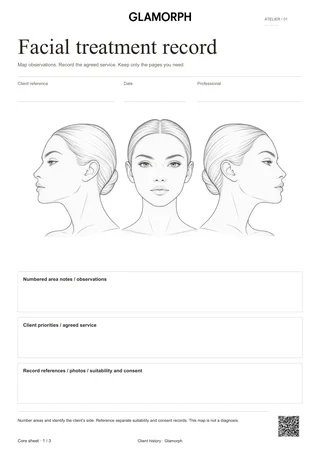
Circle or number areas with your PDF reader’s drawing tools, or annotate a printed copy. Identify the client’s side where needed. The illustration is a general reference, not a diagnostic map or a set of prescribed treatment zones. Record observations in neutral language and link them to dated photos when helpful.
The product table has no prefilled steps, settings or timings. Write what was actually used and follow the relevant product instructions and your professional scope. Leave irrelevant cells blank. Use another page if a service needs more rows. Keep consultation, suitability and consent records separate, and reference them on page one. This workbook does not replace them.
Save a completed copy, reopen it and check both typed entries and drawn annotations. Attach it to the dated Glamorph session with the relevant photos. Later feedback belongs in a new dated review or on the optional third page, so it stays distinct from what was known during the treatment. Photo publication still needs separate permission.
What should an esthetician client record include?
The complete record has three layers: a client profile, a document history, and one treatment note for every visit.
- Client profile: contact details, goals, preferences, and client-reported allergies, sensitivities, or previous reactions.
- Documents: current intake answers, service consent, signature, date, document version, and a separate photo-use choice.
- Treatment note: what was planned, what was actually done, products and relevant settings, observations, client feedback, result, aftercare, and next plan.
- Photos and follow-up: dated before, progress, and after images connected to the correct session, plus later feedback or contact.
- Business record: price, deposit, balance, tip, payment method, and status for that visit.
The Associated Skin Care Professionals recommends updating the service record with every treatment and documenting the consultation, treatment plan, and products while the details are fresh. Its esthetician client-record guidance is a useful professional workflow reference. Your local record requirements may be more specific.
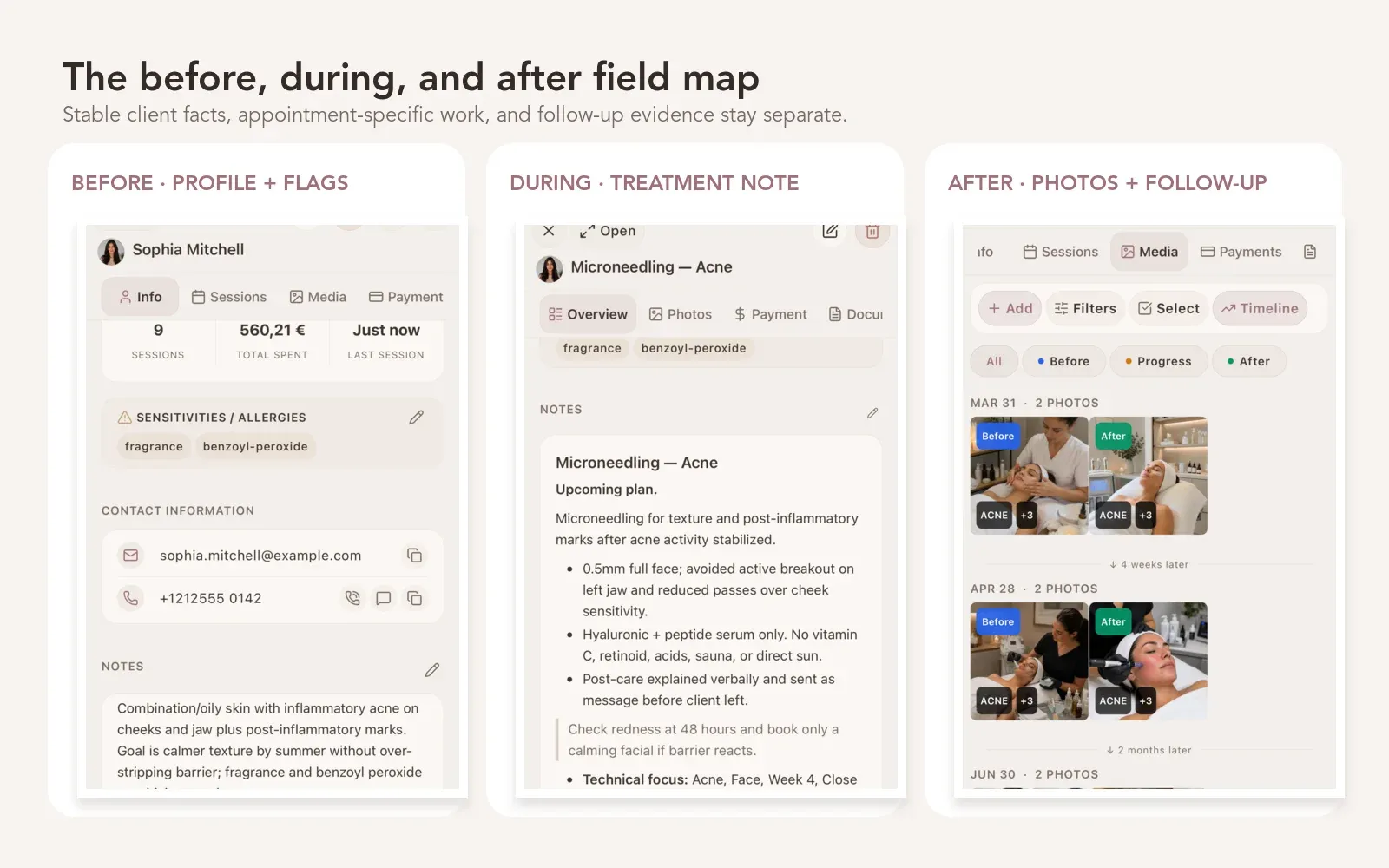
Stable client facts, appointment-specific work, and follow-up evidence are easier to trust when they are connected but not mixed into one note.
What should you record before an esthetician treatment?
Before the service, you should be able to answer four questions: who is this client, what do they want, what relevant information did they report, and what exactly are they agreeing to today?
Keep stable details on the client profile
Use the profile for information you need to see across visits:
- Full name and reliable contact details
- Preferred way to receive appointment or follow-up information
- General service goals and preferences
- Client-reported allergies, sensitivities, or previous reactions
- Relevant products or services the client says they currently use or recently received
- Comfort preferences and communication notes
- Emergency or guardian details only when your rules genuinely require them
Write what the client reports without turning the note into a diagnosis. “Client reports fragrance sensitivity and redness after a previous product” is a useful record. “Allergic skin” is vague and sounds like a conclusion you may not be qualified to make.
Collect only what you need for a defined purpose. For businesses subject to the GDPR, the European Commission’s data-minimisation guidance says personal data should be limited to what is necessary, kept accurate, protected, and retained no longer than needed for that purpose.
Use intake to collect information, not to prove consent
An intake or consultation form collects the client’s current answers, goals, relevant history, and questions. It does not automatically show that the client understood and agreed to a particular service.
A useful intake review includes:
- What result are you hoping for?
- What has changed since your last appointment?
- Have you had this service before?
- Have you had a reaction or sensitivity that may be relevant?
- Which recent products, services, or changes need to be considered under this protocol?
- Is there anything you want me to avoid or explain before we begin?
Do not collect the form and then ignore it. Review the answers, clarify anything important, and record changes before the service starts.
Keep service consent and photo permission clear
Consent should identify the planned service, important explanations, the client’s questions, agreement, date, signature or other valid confirmation, and the version of the document shown. Photo permission should say whether images are private treatment records, allowed in a portfolio, allowed on social media, or not approved for publication.
Those are different decisions. A client can agree to a facial and refuse marketing use of their image. Keep consultation, service consent and photo permissions as separate client documents, each linked to the appropriate client or visit.
What should you record during the treatment?
Record what you actually did. A booking name such as “facial” or “peel” is not a treatment note.
At minimum, the session should identify:
- Date, time, professional, service, and area
- The client’s stated goal for this visit
- Relevant pre-service observations, written within your scope
- Products used, including brand and exact product where useful
- Strength, timing, layers, device, setting, or batch details when required by your protocol
- Technique or sequence that future you needs to repeat or change
- Areas avoided or adaptations made
- What the client reported during the service
- Any unexpected response and the action you took
- Whether the service was completed, changed, paused, or stopped
Use facts instead of judgment.
| Too vague | More useful treatment record |
|---|---|
| “Sensitive” | “Client reported stinging after product two. Product removed and service adapted under protocol.” |
| “Used peel” | “Product, strength, layers, timing, treated area, and neutralisation or removal recorded.” |
| “Skin looked better” | “Immediate appearance recorded in neutral terms. After photo attached with date and lighting note.” |
| “Same as last time” | “Previous session opened. Products, parameters, changes, and today’s response recorded again.” |
The note should make sense to you weeks later and, where a team is involved, to the authorized professional reviewing the history. Glamorph’s session tracking keeps each visit separate while preserving the chronological client record.
What should you record after the treatment?
Finish the record before the details disappear. Leave enough scheduled time to complete it rather than relying on memory at the end of the day.
Record:
- The immediate result in neutral, observable language
- What the client said about comfort and outcome
- Aftercare explained, sent, or provided
- Products recommended or supplied, if relevant
- What the client should do under your established protocol if they have a concern
- Whether follow-up is planned and when
- What to review, repeat, avoid, or change next time
- Before, progress, or after photos attached to this session
- Price, deposit, balance, tip, method, and payment status
Do not silently edit an old signed document or treatment note when new information arrives. Add a dated follow-up note or a new document so the sequence remains understandable.
Treat follow-up as part of the history
A follow-up note can be short:
48-hour check-in sent. Client reports [their words]. Photo received and attached. Advice followed the business’s established aftercare and referral protocol. Review again on [date] or before the next service.
If the client reports a concerning response, follow the escalation, referral, emergency, insurer, or manufacturer process that applies to your work. The record supports that process. It does not replace professional judgment.
How are intake, consent, treatment notes, and aftercare different?
They should connect to the same client, but they should not be treated as interchangeable.
| Record | Main question it answers | When to complete it | What should not be substituted for it |
|---|---|---|---|
| Intake or consultation | What is the client telling me before the service? | Before the first relevant service and whenever important information changes | A signature alone |
| Service consent | What was explained and what did the client agree to? | Before the service covered by that document | A generic intake form |
| Treatment note | What did I actually do and what happened? | During and immediately after every visit | The booking title or consent form |
| Aftercare | What information did the client receive after the service? | At or after the appointment | A vague note saying “aftercare given” when the exact instructions matter |
| Follow-up note | What happened after the client left? | When contact, feedback, a photo, or a change is received | Editing the original note as if the later information was known earlier |
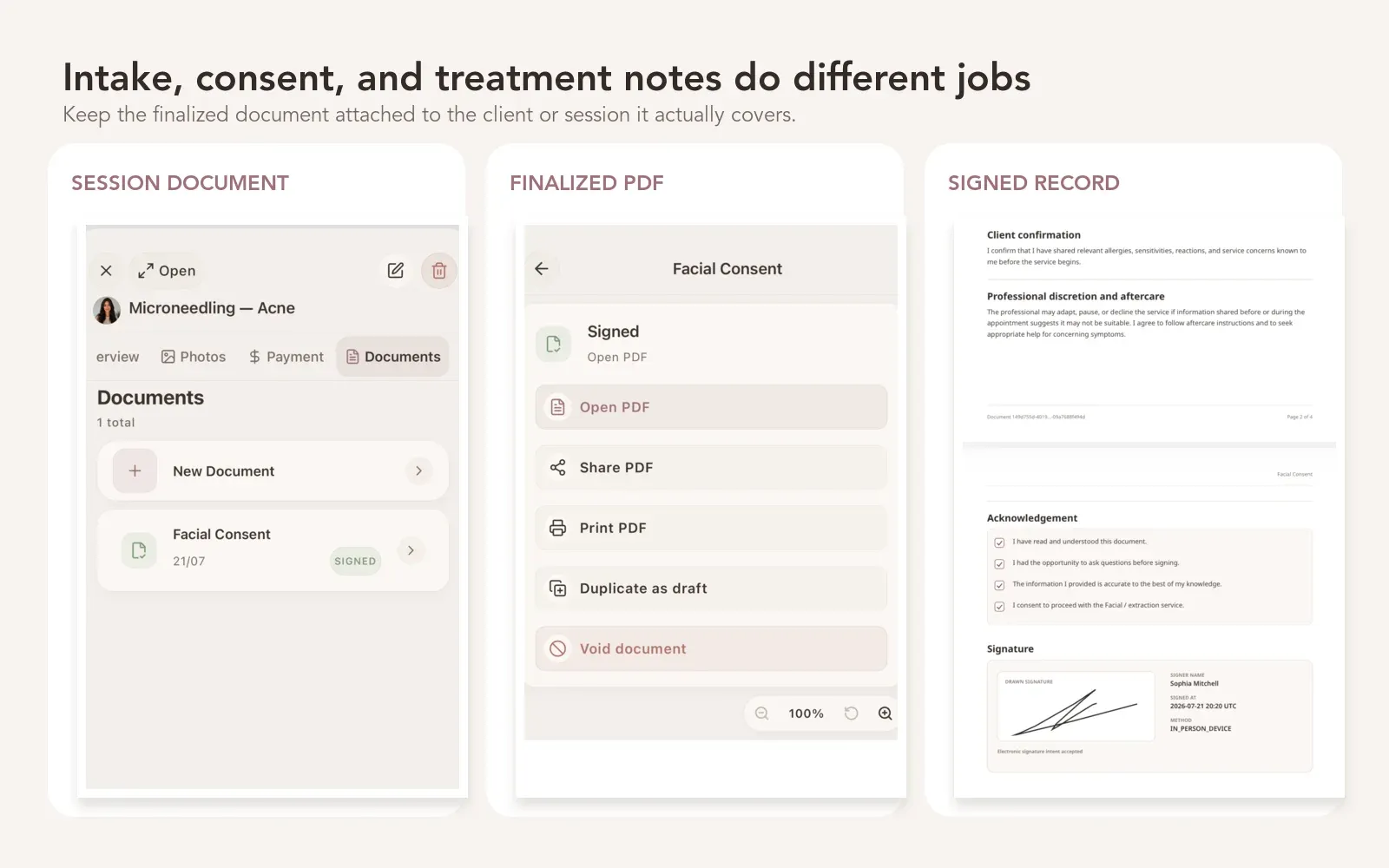
A finalized document should remain retrievable beside the client or session it covers. Glamorph can open, share, print, duplicate as a new draft, or void the record without rewriting the signed original.
Glamorph’s client documents connect intake, consent, aftercare, and signed PDFs to the relevant client or session. Templates still need professional and legal review for your own service and location.
How should estheticians organize progress photos?
Attach each image to the client and treatment session, then label the stage consistently.
A practical photo record includes:
- Date and session
- Before, progress, or after stage
- Treated area and useful orientation
- Consistent lighting, angle, distance, and camera when practical
- Relevant service or goal tag
- Whether the image is private, shareable with the client, or approved for a specific marketing use
- A note when lighting, makeup, camera, or timing makes comparison unreliable
Do not use a progress photo to promise a result or diagnose a condition. It is a dated visual record with context.
Keep permission specific. The UK’s Information Commissioner’s Office explains that valid consent should be freely given, specific, informed, unambiguous, and genuinely withdrawable in its consent guidance. Other countries may use different rules or lawful bases, so review the requirements that apply to you.
Glamorph’s before-and-after photo workflow connects dated images to the client and session instead of leaving them in a mixed camera roll.
What does a useful esthetician treatment-note template look like?
Use this as a field map, then remove anything that does not serve your workflow and add anything your professional rules require:
- Appointment: date, professional, service, area, and duration.
- Client update: goal today, what changed, and relevant products or recent services reported by the client.
- Pre-service review: sensitivity flags, relevant intake, current consent, and photo choice reviewed.
- Treatment: planned and actual products, parameters, timing, areas included or avoided, feedback, and adaptations.
- Closeout: neutral result, photos, aftercare, follow-up, next-visit note, and payment status.
Example of a concise session note
- Service: [service and area]
- Client update: [what changed and what the client reported]
- Plan: [products, parameters, timing, and areas to avoid]
- During: [what actually happened, client feedback, and any adaptation]
- After: [neutral result, aftercare provided, photos, and payment status]
- Next: [follow-up date and what to review]
The structure matters more than writing a long paragraph. If a field does not help you prepare, provide, document, or follow up on the service, question why you collect it.
How do you find the last treatment before the next appointment?
Open one client profile and start with the most recent session, not a global stream of appointments or photos. In under a minute, you should be able to see what was done, the exact products or settings, the client’s response, the result photos, aftercare, and the note about what to repeat or change.
Then confirm what has changed directly with the client. A previous record prepares the conversation. It does not replace a current consultation. When the client uses online booking, the appointment should reach the same calendar and client history you will review before the service.
Glamorph for estheticians keeps the client profile, reported sensitivities, sessions, products, photos, finalized documents, payments, appointments, and follow-up context together across iPhone, Android, and web. Try one fictional client with two visits, then check that you can retrieve the earlier products, photos and documents before adding the next record.
It is not an electronic medical record, diagnostic system, fiscal POS, inventory platform, or complex spa operations suite. If one of those is your main requirement, choose the system built for that job. If the problem is reconstructing a client’s treatment story from forms, notes, camera rolls, and payment screenshots, Glamorph is designed for that exact workflow.
Esthetician client-record checklist
Use this before closing each client file:
- The client profile has current contact details and only necessary information.
- Client-reported allergies, sensitivities, previous reactions, and important changes are visible.
- The intake or consultation answers were reviewed, not only collected.
- The correct service consent and document version are attached.
- Private treatment photos and marketing permission are treated as separate choices.
- The treatment note says what actually happened, including products and relevant parameters.
- Adaptations, client feedback, and any unexpected response are factual and dated.
- The result, aftercare, follow-up, and next plan are complete.
- Photos are attached to the correct client and session with consistent stage labels.
- Deposit, balance, payment, and tip status are recorded.
- Later information will be added as a dated follow-up, not written over the original record.
- The record can be retrieved on the device and in the room where it will be needed.
Frequently asked questions
Should an esthetician update the client record after every treatment?
Yes as a professional workflow: every treatment should have its own dated note, even when the service appears unchanged. ASCP specifically recommends updating the service record with every treatment. The exact mandatory fields and retention period still depend on your services and location.
Is a client card the same as a treatment note?
No. The client card or profile holds details that remain relevant across visits. A treatment note records one appointment: what was planned, what was done, how the client responded, aftercare, photos, payment, and what to review next.
Can a signed consent form replace the treatment record?
No. Consent records what was explained and agreed before the service. The treatment note records what actually happened. Keep both connected to the same client or session.
How long should estheticians keep client records?
There is no safe universal period. Licensing bodies, insurers, tax rules, privacy law, service type, and rules for minors can all affect retention. Define and document a local retention policy, keep data no longer than necessary where that principle applies, and obtain professional advice for your jurisdiction.
Should before-and-after photos be part of the client record?
They can be useful when they are dated, consistently captured, connected to the correct treatment, stored securely, and covered by the appropriate privacy and permission workflow. Permission to keep a private record photo is not automatically permission to publish it.
Written by
Professional makeup artist and founder of Glamorph
Makeup artist and Glamorph founder with 5+ years of experience. Working closely with professionals across the beauty industry, she writes about client management, booking and everyday salon workflows.